 info@slovklima.sk
Heat Pump Performance: What Affects It and How to Choose the Right Solution


A heat pump’s capacity is one of the most important factors to consider when making a selection. This is only natural. It is the capacity that determines whether the system will be able to reliably heat the building, provide hot water, and, in some cases, cool it as well. At the same time, however, it’s not worth judging a heat pump’s performance based solely on a single number in the technical specifications.
Many people view performance in simple terms: the higher, the better. In practice, it doesn’t work that way. A solution that’s too weak may not meet the building’s needs, but an unnecessarily oversized system isn’t ideal either. That’s exactly why it’s worth understanding what a heat pump’s capacity actually means, what influences it, and why proper design is more important than the specific value listed in the specifications.
What Does Heat Pump Capacity Actually Mean?
When we talk about a heat pump’s capacity, we usually mean its ability to transfer the necessary amount of heat to the heating system. Simply put, it refers to how much heat the unit can deliver to a building under specific conditions.
However, there is one important thing to note here. A heat pump does not operate under the same conditions throughout the year. Its performance may vary in milder weather compared to when outdoor temperatures are lower. That’s why it’s not enough to look only at the rated capacity without knowing the conditions under which it was specified.
In practice, therefore, a heat pump’s performance isn’t just about “how many kilowatts it has,” but also how the unit behaves in actual operation and whether it can deliver the necessary heat exactly when the building needs it most.
The heat pump’s capacity must match the building’s needs
The most important factor in choosing a heat pump is simple. The heat pump’s capacity must be suited to the specific building. A new building with low heat loss has different requirements than an older home that has undergone partial renovation, and a larger building with higher demands for both heating and hot water has different requirements as well.
The required capacity is primarily influenced by:
- the building’s heat loss,
- level of insulation,
- the quality of the windows and building structures,
- the size of the heated area,
- how the space is used,
- hot water heating requirements.
That is precisely why it is not a good idea to choose a heat output based only on the house’s floor area or on what someone else has in a similar building. Two houses with the same floor area can have completely different heat losses and, therefore, different heat output requirements.
Too low a capacity is a problem, but too high a capacity isn’t necessarily a solution either
With heat pumps, there is sometimes a concern that if the capacity is too low, the system won’t be sufficient. That’s true, but it’s equally important to consider the other side of the coin. Even a heat pump with too high a capacity isn’t usually the ideal solution.
If the system is undersized, it may struggle to meet the building’s needs on colder days. This can result in reduced comfort, more frequent use of a supplementary heat source, or increased strain on the system.
However, if the unit is unnecessarily oversized, it may operate less smoothly, cycle on and off more frequently, and the resulting operation may not be as efficient as expected. While power regulation in modern inverter-based units is significantly better than in older systems, it remains true that the best results come from a properly designed solution, not from unnecessary power reserves.
Heat pump capacity is also related to the type of heating system
The building’s heating system also plays a very important role. A heat pump operates differently when connected to underfloor heating than when it must produce higher water temperatures for radiators.
In a low-temperature system, operation is naturally more favorable. The heat pump does not need to operate at such a high water outlet temperature, which generally suits it better. However, if the building requires higher temperatures, not only can efficiency be affected, but so can the actual capacity needed under real-world conditions.
This is one reason why a heat pump’s capacity is not evaluated separately from the heating system. It’s important to know:
- whether the system uses underfloor heating,
- whether radiators are used,
- whether fan coils are also being used,
- what water temperature the system will require.
It is precisely these factors that significantly influence which solution will truly be suitable for the building.
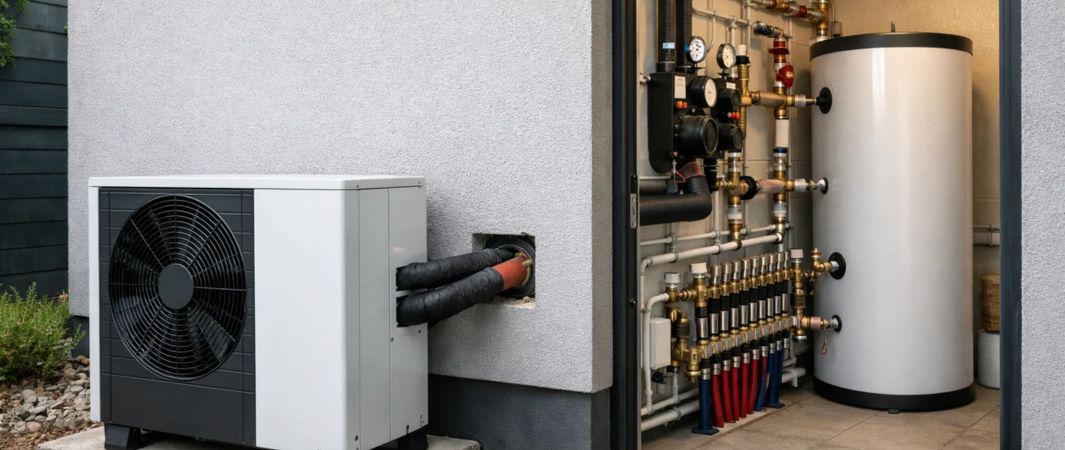
It’s not just about heating, but also about hot water and sometimes cooling
When making a selection, the focus is often primarily on heating, but the heat pump’s capacity may also be related to other requirements. Domestic hot water is often very important. If there are more people in the building or higher daily water consumption, the system must also cover this aspect of operation.
In some cases, cooling is also taken into account. While this shifts the focus of the system slightly in a different direction, the principle remains that the design should not be based on just one function. A heat pump can be part of a broader concept, and its performance must meet your expectations throughout the entire year.
Therefore, when designing the system, it’s worth considering more than just:
- heating,
- but also domestic hot water (DHW) production,
- any cooling needs,
- and the overall use of the building.
Heat Pump Capacity and Actual Operation
It is also very important to note that the capacity listed in the technical specifications does not necessarily translate to the same performance in everyday operation. Actual results are also influenced by control systems, hydraulic connections, system settings, and the quality of installation.
In practice, therefore, it is not enough to have the correct capacity “on paper.” It is equally important that:
- the system is properly designed,
- it is properly connected,
- the heating curves are set correctly,
- and that the entire solution functions as a single, logical unit.
This is precisely where the difference often becomes apparent between a system that, while technically correct, does not function optimally, and a solution that is thoughtfully designed and performs well in everyday use.
How to Properly Assess Performance
To make a sensible choice, it helps to ask yourself a few basic questions:
- What is the building’s heat loss?
- what kind of heating system is currently in place,
- whether domestic hot water will also be addressed,
- whether the priority is only heating or also cooling,
- and how the building will actually be used.
It is precisely these answers that will reveal more about the required capacity than simply comparing two units based on their names or a single performance value.
Conclusion
Heat pump capacity is one of the key parameters, but it is not enough on its own to make the right choice. It must always be considered in the context of the building, the heating system, hot water production, and the overall design of the solution. That is precisely why it is not worth choosing based on the assumption that a more powerful unit will automatically be better.
For a heat pump to operate reliably and efficiently, its capacity must match the actual needs of the building. At Slovklime, they can help you take all the important factors into account and design a solution that makes sense not only from a technical standpoint but also in terms of day-to-day operation.
