 info@slovklima.sk
Air Conditioner Brands: How to Choose Between AUX, GREE, and TOSHIBA


When choosing an air conditioner, many people first look at the price, performance, or appearance of the indoor unit. However, they very quickly move on to the next question: which air conditioner brands actually make sense, and what criteria should they use to choose between them? At first glance, it may seem that a brand is just a name on the unit. In practice, however, it often reveals the company’s approach to technology, model lines, features, controls, and the product’s overall focus.
However, that doesn’t mean there’s one universal best choice for everyone. When it comes to air conditioners, the manufacturer’s name isn’t the only deciding factor. What matters is the type of space the unit will be installed in, how often it will be used, and what your expectations are regarding noise levels, air filtration, controls, and energy efficiency. That’s exactly why it pays to look at air conditioner brands pragmatically, not just through advertising or the price list alone.
Air conditioning brands differ in more than just price
When comparing brands, people often focus only on how much the unit costs. Price is important, but it alone doesn’t tell you whether a particular air conditioner will be suitable for your apartment, house, or business space.
Another difference between brands may lie in:
- what model lines they offer,
- what type of customer they target,
- which features come standard and which are part of higher-end packages,
- what control options are available,
- the emphasis they place on quiet operation, filtration, or design.
In practice, this means that two air conditioners with similar capacity may be suitable for completely different types of use. One might appeal to someone looking for a practical solution for an apartment, while the other might be better suited for someone prioritizing greater comfort, more frequent use, or a stronger emphasis on technical quality.
AUX as a practical solution
The AUX brand may be a good choice, especially if you’re looking for a functional solution that offers a reasonable balance between price, performance, and features. When making this choice, the most important factor is usually that the air conditioner reliably handles everyday use in an apartment, house, or small office space.
AUX can therefore appeal to people who don’t want to unnecessarily complicate their choice but still expect a modern solution for everyday use. In practice, this is often an attractive option, especially when the priority is practicality and a sensible technical solution without the need for unnecessarily complicated requirements.
However, that doesn’t mean that price is the only factor to consider with AUX. Even with a brand like this, it’s still important to consider the specific model, the size of the space, and what you realistically expect from the air conditioner. Even a more affordable solution can work very well if it’s chosen correctly and designed for a specific space.
GREE is one of the most widely used air conditioning brands
GREE may be particularly appealing to customers who want a wider selection of different types of solutions. One advantage of this brand is its broader product portfolio, which makes it easier to find solutions for both smaller and larger spaces.
This is especially important when you don’t want to choose based on just one specific model, but want to explore multiple options within a single brand. GREE can therefore be a good choice when you’re looking not just at basic cooling, but also at a wider range of options based on the specific space and how it will be used.
In practice, this brand may be appealing to customers who want some flexibility in their choice and wish to compare multiple models with different features. However, the same principle applies here: you won’t make the best choice by selecting a model based solely on its name. What matters is which specific model is right for your space and your expectations.
TOSHIBA appeals to those who also consider technical details
TOSHIBA may be particularly suitable for those who, when making a selection, consider not only the basic specifications but also the overall operating characteristics, technical design, and comfort during long-term use.
With this brand, there is often a focus on quieter operation, operational stability, or a greater emphasis on technical design. This can be particularly beneficial when you’re not just looking for basic air conditioning, but for a solution that will perform well over the long term.
That doesn’t mean TOSHIBA is only suitable for discerning customers. Rather, it’s a brand where many people pay closer attention to the subtle differences in the unit’s performance, its operating characteristics, and how the entire system functions during everyday use. This can be particularly important in certain spaces.
Air Conditioning Brands and the Differences in Who They’re Best Suited For
When making a choice, it’s helpful to ask yourself a simple question: what do you realistically expect from an air conditioner? The answer to this question often matters more than the brand itself.
If you’re looking for an air conditioner for a smaller apartment and mainly want reliable cooling without an unnecessarily complicated selection process, your approach may differ from that of someone who wants an air conditioner for a single-family home and plans to use it regularly for temporary heating as well.
In practice, therefore, it’s worth considering the following:
- if the priority is a sensible solution for everyday use, the balance between price, features, and performance will be important;
- if a wider selection of models and options is the priority, the brand’s product portfolio will be important,
- if the priority is technical detail, quieter operation, or a greater emphasis on comfort, the brand may play a larger role in terms of the overall user experience.
This is where it becomes clear that air conditioning brands are about more than just the logo on the unit. Each one may be suitable for a different decision-making approach.
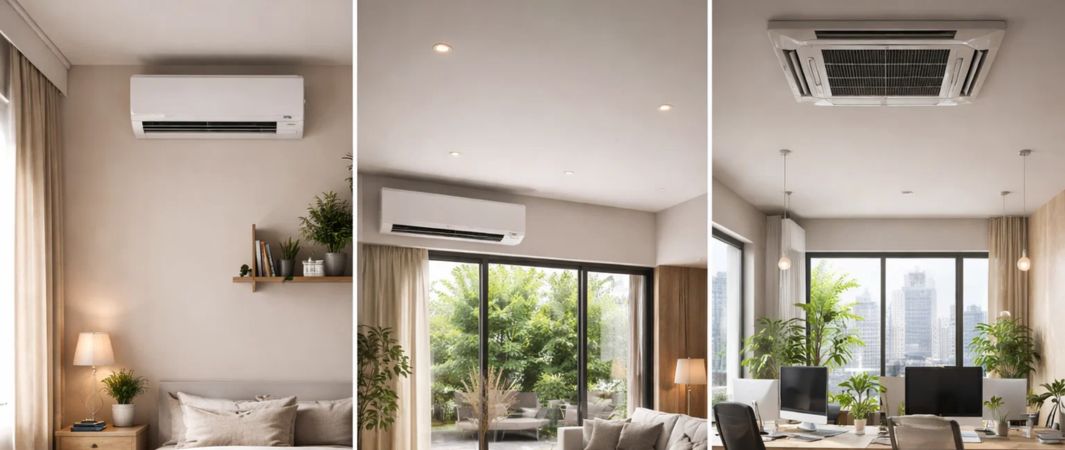
When choosing a brand, it’s not enough to just look at the name
Even a strong brand may offer both simpler and more advanced models. That’s why it’s not worth making a decision based solely on the manufacturer’s name. It’s much more important to look at the specific model line and what the device actually offers.
The following are particularly important:
- performance relative to the size of the space,
- energy efficiency,
- noise levels of the indoor and outdoor units,
- remote control options,
- air filtration,
- unit design and dimensions,
- service support and availability of solutions.
In practice, this means that even if someone says they want a GREE or a TOSHIBA, they still need to determine which specific model is suitable for their space. This is precisely where the biggest difference between a good choice and an average one lies.
It’s also worth evaluating air conditioning brands based on the space
The choice of an air conditioner differs depending on whether it’s for a bedroom, an open-concept living room, an office, or a commercial space. Some models may be more suitable for places where quiet operation is a priority. In other cases, performance, reliability during extended operation, or the ability to use the unit regularly throughout the year will be more important.
Therefore, it’s a good idea to consider the following questions when making your decision:
- Will the air conditioner be used only for cooling, or also for heating?
- Will it be used occasionally or on a daily basis?
- Is the space smaller and enclosed, or open and larger?
- Is a simple solution a priority, or greater comfort and features?
- Is the unit’s appearance in the interior also important?
When you look at air conditioner brands through the lens of these practical questions, your choice tends to be much more precise and meaningful.
Conclusion
It’s worth comparing air conditioner brands, but not just based on the name or price. AUX, GREE, and TOSHIBA can all be good choices if you select them based on the specific space, intended use, and operational expectations. Each brand can be a good fit, but for slightly different types of customers and different types of requirements.
If you want to choose an air conditioner that makes sense not only on paper but also in real-world use, it’s important to consider the brand in a broader context. At Slovklime, they can help you figure out which option— AUX, GREE, or TOSHIBA—might be best suited for your needs and design a solution based on the actual requirements of the space.
