 info@slovklima.sk
More Environmentally Friendly Refrigerants: The Transition to Sustainable Solutions in the Refrigeration Industry

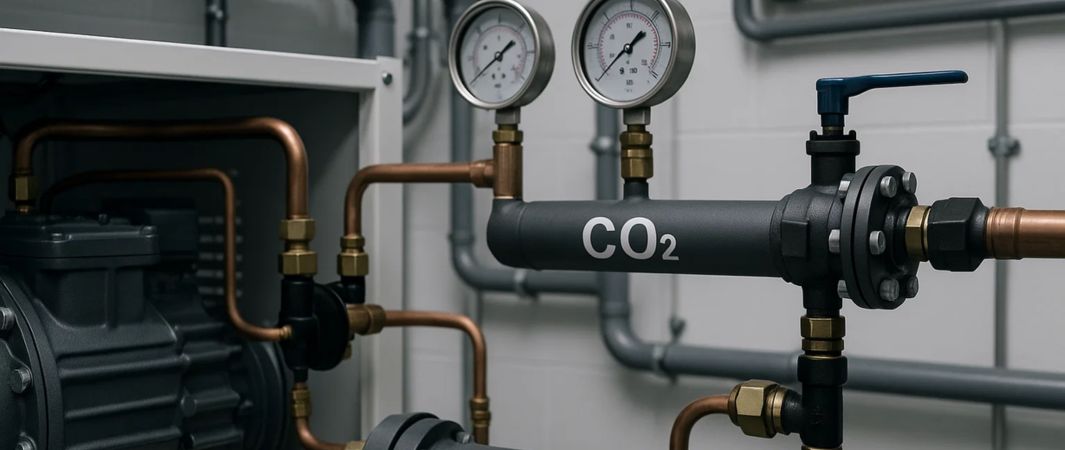
Refrigeration and air conditioning systems are now an integral part of industry, logistics, commerce, and buildings. They ensure comfort, safe food storage, and stable conditions for technology. A key component of these systems is refrigerants —substances that transfer heat.
However, refrigerants are also one of the biggest environmental problems in the industry. Older generations of refrigerants damaged the ozone layer; while newer ones do not threaten the ozone layer, they have a very high global warming potential (GWP). European legislation is therefore gradually pushing the sector to transition to more environmentally friendly refrigerants—those with a low or negligible impact on the climate.
In this article, we’ll examine why refrigerants are such an important topic, what types of refrigerants exist, which ones are considered more environmentally friendly, and what the transition to new refrigerants means in practice for operators of refrigeration and air conditioning systems.
Why Refrigerants Are a Topic of the Future in the Refrigeration Industry
During operation, refrigerants continuously evaporate and condense in a closed loop, transferring heat from the cooled part of the system to the surrounding environment. The problem arises when refrigerant escapes from the circuit into the atmosphere—through leaks, during maintenance, or when the equipment is disposed of.
Historically, the following were used:
- CFC and HCFC refrigerants —these had a high ozone depletion potential (ODP) as well as a high GWP. As a result, they were gradually phased out under the Montreal Protocol.
- HFC refrigerants —do not deplete the ozone layer, but their GWP is often very high (for example, R404A with a GWP of around 3,900), so when leaked, they contribute significantly to global warming.
The European Union has therefore adopted and strengthened the F-Gas Regulation (EU 2024/573), which aims to significantly reduce the use of fluorinated greenhouse gases—particularly HFC refrigerants. The goal is a virtually complete phase-out of HFCs by 2050, with significant reductions already in place by 2030.
For operators, this means:
- increasing pressure to use low-GWP or natural refrigerants,
- Gradual restrictions on equipment with high GWP,
- the need for long-term planning—so that equipment isn’t “stranded” in a few years without access to refrigerant or service.
Types of Refrigerants: From Traditional to More Environmentally Friendly Refrigerants
Today, refrigerants can be broadly categorized into several groups based on their environmental impact and physical properties.
CFCs and HCFCs—refrigerants of the past
- high ODP (ozone depletion potential),
- high GWP,
- in the EU, they are now found only in legacy systems; their use has practically ceased.
Today, these refrigerants are primarily a concern when addressing the retrofitting of old equipment and their environmentally sound disposal.
HFCs – a transitional generation with high GWP
HFCs (hydrofluorocarbons) have replaced CFCs and HCFCs because they have no ODP. The problem remains:
- a very high GWP —in the event of a leak, they significantly increase the carbon footprint,
- increasing legislative restrictions (quotas, bans in certain applications).
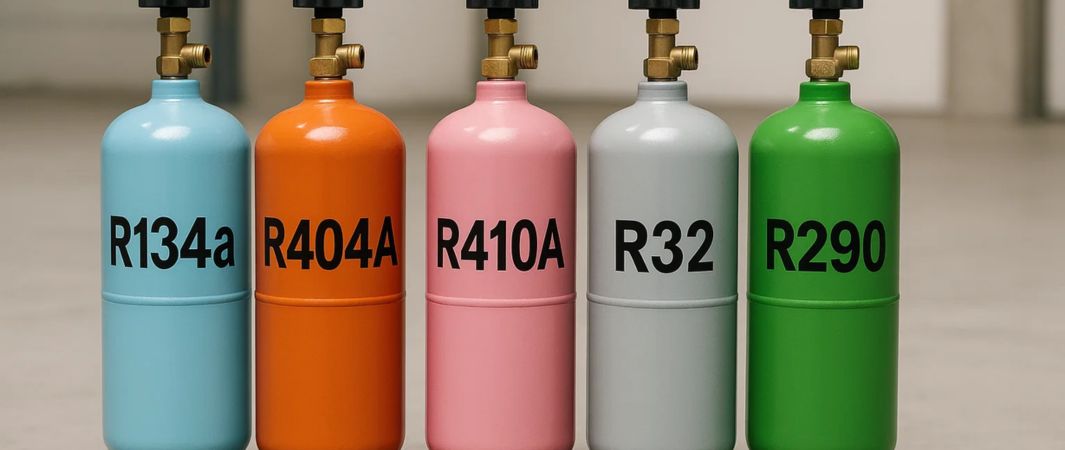
Examples: R404A, R410A, R134a, and some of the blends used in older refrigeration and air conditioning systems.
HFO and low-GWP blends
HFOs (hydrofluoroolefins) are synthetic refrigerants with a very low GWP (often < 10) and zero ODP. They are often used alone or in blends with HFCs to achieve a lower GWP while maintaining properties similar to those of well-known HFC refrigerants.
Benefits:
- low GWP,
- zero ODP,
- good compatibility with existing technologies.
Disadvantages may include:
- higher purchase price,
- moderate flammability (Class A2L), which requires compliance with specific safety regulations.
Natural Refrigerants
These include substances that occur naturally:
- CO₂ (R744) – GWP = 1, ODP = 0, high operating pressures, particularly suitable for commercial and industrial refrigeration or heat pumps.
- Ammonia (NH₃, R717) – GWP ≈ 0, ODP = 0, excellent efficiency, but toxic; used primarily in industrial refrigeration.
- Propane (R290) – GWP approximately 3, ODP = 0, excellent thermodynamic properties, but highly flammable (A3); used in compact units, heat pumps, and commercial refrigeration.
Natural refrigerants are often the ideal choice from an environmental perspective, but they require proper design, safety measures, and a higher level of technical expertise in both design and service.
More Environmentally Friendly Refrigerants in Practice: CO₂, Ammonia, Propane, and HFOs
The transition to more environmentally friendly refrigerants is not just a theoretical topic—we are already seeing concrete applications in real-world projects today.
CO₂ (R744)
Particularly suitable for:
- supermarkets and retail chains,
- industrial cold storage facilities,
- high-temperature heat pumps for domestic hot water (DHW) production.
Benefits:
- very low climate impact (GWP = 1),
- good efficiency in properly designed systems,
- the technology is becoming increasingly widespread and standardized.
Challenges:
- high operating pressures,
- the need for specific components and expertise.
Ammonia (R717)
Typically used in:
- industrial refrigeration (freezer rooms, food processing, logistics),
- large centralized systems.
Benefits:
- Excellent energy efficiency,
- GWP ≈ 0 and no damage to the ozone layer.
Disadvantages:
- toxicity—places stringent demands on safety measures, machine room location, and leak monitoring.
Propane (R290) and other hydrocarbons
In practice, R290 is primarily used in:
- compact refrigeration units and display cases,
- heat pumps and smaller air conditioning units,
- applications where the amount of refrigerant in the circuit can be limited.
Benefits:
- very low GWP,
- high efficiency,
- good availability.
Disadvantages:
- high flammability—requires adherence to refrigerant charge limits, proper design, and safety measures.
HFO and low-GWP blends
HFO and HFO/HFC blends are a common choice in situations where:
- compatibility with existing technologies is required,
- natural refrigerants are not ideal for safety or space-related reasons.
Examples:
- R1234yf, R1234ze(E) – very low GWP (around 1–4), zero ODP; used in automotive air conditioning, refrigerators, and large air conditioning systems.
Transition to More Environmentally Friendly Refrigerants in Existing Systems
Not every facility can replace its equipment “overnight.” The transition to more environmentally friendly refrigerants often takes place gradually.
The options are:
- Retrofit (refrigerant replacement) – In some systems, it is possible to replace an HFC refrigerant with a mixture having a lower GWP (such as an HFO/HFC blend) without completely replacing the equipment. However, it is necessary to assess compatibility with oil, components, and pressure conditions.
- Partial retrofit – replacement of key components (compressors, heat exchangers, controls) and transition to a different refrigerant within the existing system.
- Complete system replacement —particularly where the equipment is at the end of its service life or where modifications would be technically or economically inefficient.
It is important to:
- monitor legislative deadlines for the phase-out of specific types of equipment and refrigerants,
- consider the future availability of refrigerants and service capabilities,
- not to evaluate only the “price of the refrigerant,” but the total operating costs and risks.
Legislation and Standards: Refrigerants Under the Microscope
The new F-gas Regulation (EU 2024/573) introduces:
- a stricter phase-down of HFC refrigerants —a significant reduction in the permitted amount of HFCs on the market as early as 2030,
- gradual bans on equipment with high GWP in various segments (refrigeration, air conditioning, heat pumps),
- a push toward the use of natural refrigerants and low-GWP alternatives.
For operators, this also entails the following obligations:
- keeping records of refrigerant quantities in equipment,
- ensuring regular leak checks for larger charges,
- use certified companies and technicians when handling F-gases.
Proper system configuration, minimizing leaks, and choosing more environmentally friendly refrigerants are therefore not just “voluntary eco-friendly gestures,” but also a matter of compliance with applicable legislation.
How to Choose Equipment with More Environmentally Friendly Refrigerants
When choosing a new refrigeration, freezing, or air conditioning system, it’s worth taking a comprehensive look at refrigerants:
- GWP and ODP —basic indicators of environmental impact,
- energy efficiency – high efficiency can affect the overall carbon footprint even more than the refrigerant’s GWP alone,
- safety – toxicity, flammability, operating pressures; the classes defined by EN 378 (A1, A2L, A3, etc.) are important,
- availability of service and replacement parts —long-term sustainability of the solution,
- total cost of ownership (TCO) —not only the purchase price, but also energy, service, and potential costs associated with future regulations.
For many projects today, a combination of
- natural refrigerants (CO₂, R290, NH₃) where technical and safety conditions permit,
- HFO and low-GWP blends in applications where compatibility and specific operating conditions are important.
Conclusion
Refrigerants have evolved from a technical detail into one of the key topics in the sustainable refrigeration and air conditioning industry. The transition to more environmentally friendly refrigerants is not just a trend, but a real requirement of both legislation and the market—ranging from CO₂ systems to ammonia and propane, all the way to low-GWP HFO blends. The right refrigerant can reduce the carbon footprint, increase energy efficiency, and prepare equipment for future regulatory changes.
If you are planning to upgrade existing systems or design a new refrigeration or air conditioning system, it’s worth paying just as much attention to the choice of refrigerant as to the choice of the equipment itself. At Slovklima , we’ll help you navigate the options for more environmentally friendly refrigerants, design a suitable system in compliance with F-gas regulations, and ensure its professional installation and maintenance so that the solution operates reliably and sustainably over the long term.

FAQ
They help reduce the impact of refrigeration and air conditioning systems on the climate and also address increasingly stringent regulations regarding F-gases.
GWP measures global warming potential. The lower the value, the less impact the refrigerant has when it is released into the atmosphere.
These include, in particular, natural refrigerants such as CO₂, ammonia, and propane, as well as HFOs and low-GWP blends.
In some cases, yes. This may involve a retrofit, a partial upgrade, or a complete replacement of the system, depending on the technical condition of the equipment.
It is important to consider GWP, ODP, energy efficiency, safety, service availability, and total lifetime costs.
This means the need to plan for the long term, monitor legislative requirements, address service availability, and minimize the risk of refrigerant leaks.