 info@slovklima.sk
How a compressor works and why it is crucial for cooling systems

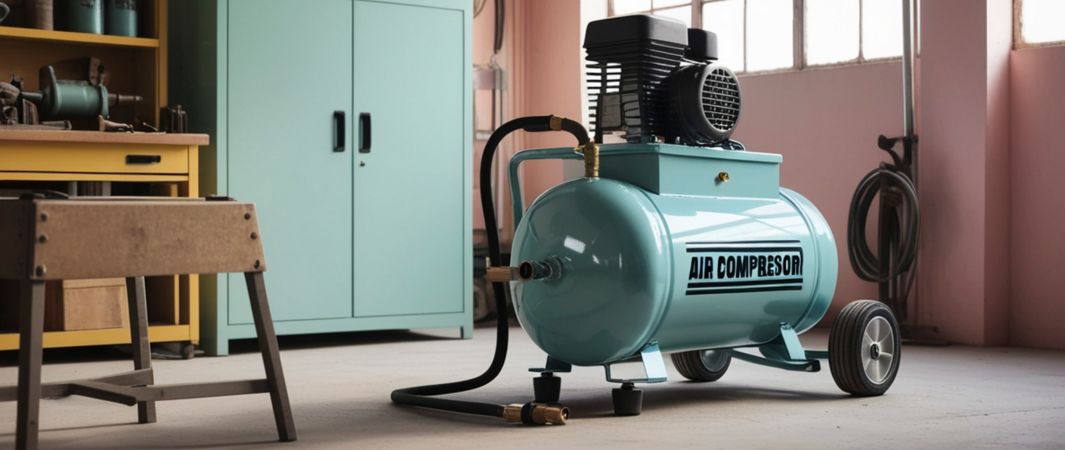
In every refrigeration system—whether it’s a freezer, industrial refrigeration, air conditioning, or a heat pump—the compressor plays a key role. To truly understand how a compressor works, just look at what happens to the refrigerant in a closed circuit and why increasing the pressure is so important.
In this article, we’ll explain why the compressor is called the “heart” of the refrigeration system, how the compressor works during each phase of the cycle, what types of compressors are used in refrigeration technology, and what factors determine their reliability and service life in practice.
Why Is the Compressor the “Heart” of the Refrigeration System?
The refrigeration cycle operates on the principle of refrigerant compression and expansion. The refrigerant circulates within the system and constantly changes its state:
- in one part of the circuit, it absorbs heat (from the space being cooled),
- in another part, it releases heat into the surroundings (for example, through the condenser into the ambient air).
The compressor ensures that the refrigerant flows through the circuit and changes its pressure and temperature as needed. Without a compressor, the refrigerant would still be present in the circuit, but the cycle would not start—there would be no “engine” to drive it forward.
In practice, this means that:
- when the compressor is working properly, the system cools (or heats) stably and efficiently,
- when the compressor fails, the entire system is usually out of operation.
That is why the selection, design and protection of the compressor is one of the key topics in the design of refrigeration technology.
What does a compressor consist of?
To better understand how a compressor works, it is worth looking at its basic parts. The specific design depends on the type (piston, scroll, screw, etc.), but most refrigeration compressors have the following elements in common:
- Compressor housing
A robust casing that protects the internal parts and ensures the tightness of the entire compression space. In hermetic compressors, the electric motor is also enclosed in one casing.
- Electric motor
It drives the compression mechanism (piston, scroll, screws). Depending on the control method, it can be a motor with a fixed speed or a motor with a frequency converter (inverter) for continuous power control.
- Compression mechanism
The “working part” itself, which compresses the gaseous refrigerant – in piston compressors, it is a piston in a cylinder, in scroll compressors, it is a pair of spirals, in screw compressors, it is a rotating screw.
- Suction and discharge elements
Suction and discharge valves or ports through which refrigerant enters the compressor and leaves it towards the high pressure part of the circuit. The correct function of these elements is crucial for efficiency and quiet operation.
- Lubrication system
The oil, channels and possibly an oil pump ensure lubrication of the bearings and moving parts. The correct return of the oil from the circuit back to the compressor is important for its lifespan.
- Compressor cooling
The compressor heats up during operation, so it is cooled either by flowing refrigerant, oil or external cooling. Overheating has a direct impact on the life of the motor winding and mechanical parts.
- Protection and control elements
Thermal protectors, pressure and temperature sensors, or compressor electronics protect the device from operating outside permitted conditions (too high pressure, overheating, missing phase, etc.).
It is precisely the combination of these elements that determines how a compressor performs in actual operation—whether it is quiet and efficient, and how long it can operate reliably in a specific refrigeration or air conditioning system.
How a Compressor Works in a Refrigeration Cycle
To understand how a compressor works, we need to look at the basic vapor-based refrigeration cycle (known as a compressor refrigeration cycle):
- The refrigerant, in its gaseous state, enters the compressor at a lower pressure and a lower temperature.
- The compressor compresses the gas to a higher pressure, which also significantly increases its temperature.
- The compressed, hot refrigerant then flows to the condenser, where it releases heat and condenses.
- After passing through the expansion valve, both the pressure and temperature of the refrigerant drop, and in the next heat exchanger (evaporator), it evaporates again and absorbs heat from the space being cooled.
The compressor is therefore the component that ensures:
- the necessary pressure difference between the high-pressure and low-pressure sections of the circuit,
- the flow of refrigerant through the circuit,
- the proper conditions for the refrigerant to condense and evaporate.
Without a compressor, the refrigerant in the circuit would not perform its function—the system simply would not cool.
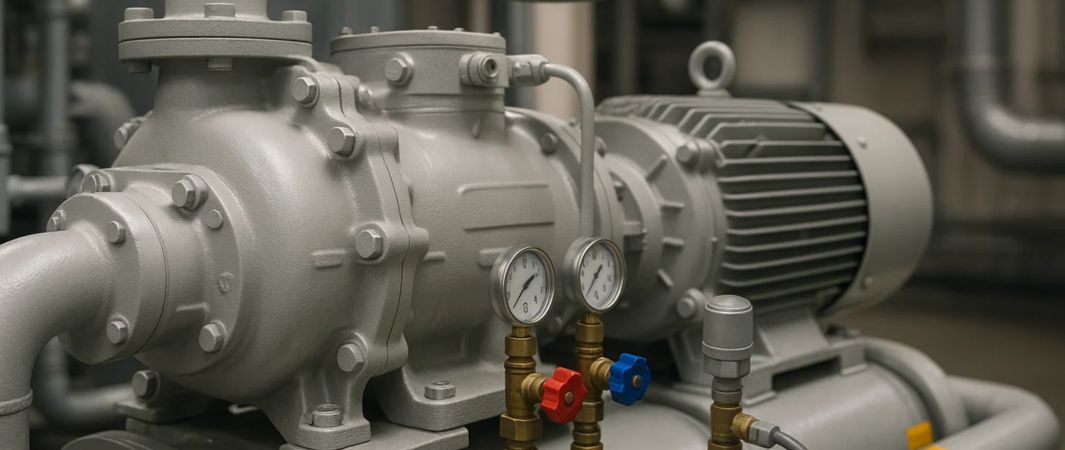
How a compressor works in practice—the individual phases
If we take a closer look at how a compressor works during a single cycle, we can divide it into three basic phases (for positive-displacement compressors, which are the most common in refrigeration technology):
- Suction
- The compressor draws in the refrigerant in its gaseous state from the low-pressure section of the circuit (behind the evaporator).
- It is important that the refrigerant enters the compressor in a superheated state—that is, without any liquid droplets—as liquid in the compressor can cause serious damage.
- Compression
- A piston, screw, or orbital element (depending on the compressor type) reduces the volume of the space containing the gas.
- This increases both the pressure and temperature of the refrigerant—the “cold” gas becomes hot, high-pressure gas.
- Displacement
- The hot, compressed refrigerant is forced into the discharge pipe and flows toward the condenser.
- At this stage, the compressor overcomes the resistance of the circuit and ensures that the refrigerant flows in the correct direction and at the correct speed.
The entire process runs continuously while the compressor is operating. Controls (such as a frequency converter in inverter compressors) adjust the power output to meet current demand—the compressor can run at full power or, conversely, in energy-saving mode.
Types of Compressors in Refrigeration Technology
Various types of compressors are used in refrigeration, freezing, and air conditioning systems. The choice depends on the capacity, temperature range, and nature of operation.
Piston (reciprocating) compressor
- operates on the principle of a piston in a cylinder, similar to an internal combustion engine,
- Suitable for low to medium power applications,
- frequently used in small refrigeration units, freezers, certain air conditioning systems, and heat pumps.
Advantages: robust construction, good efficiency under various operating conditions.
Disadvantage: more moving parts, higher noise levels compared to modern types.
Scroll compressor
- uses two interlocking spiral (scroll) elements;
- the refrigerant is gradually compressed in the chambers between the spirals toward the center.
Benefits:
- quieter operation,
- fewer moving parts,
- good efficiency—often used in heat pumps and comfort air conditioning.
Screw compressor
- uses two rotating screws that, as they turn, reduce the volume between the threads,
- suitable for medium and high capacities, often used in industrial refrigeration and large chillers.
Advantages: high reliability, smooth operation, good efficiency during continuous operation.
Rotary compressor
- frequently used in smaller, compact units and air conditioning systems,
- features a simple design in which a rotor with vanes compresses gas in an eccentrically mounted cylinder.
In addition to the type of compressor, its design is also considered:
- hermetic compressor – both the motor and the compressor are enclosed in a single housing; commonly used in small and medium-sized units,
- semi-hermetic compressor – allows for servicing of the internal components, common in industrial applications,
- open compressor – the motor and compressor are separate; used primarily in specific industrial applications.
How a Compressor Works in Terms of Efficiency and Energy Consumption
How a compressor operates in a specific system has a direct impact on electricity consumption and the overall efficiency of the refrigeration system.
Pressure ratios and temperatures
The higher the pressure the compressor must reach, the:
- more energy it consumes,
- the greater the mechanical and thermal load on it.
Therefore, when designing a system, it is important to:
- optimize both the condensation and evaporation temperatures as much as possible,
- and avoid unnecessarily high pressures (such as those caused by incorrect control settings or fouled heat exchangers).
Control Type – On/Off vs. Inverter
Traditional compressors operate in the following mode:
- on → full power,
- off → no power.
Frequent starts and stops:
- reduce efficiency,
- increase compressor wear and tear.
Inverter compressors (with a frequency converter) can continuously adjust power output according to current demand.
Benefits:
- more stable temperatures in the system,
- fewer starts,
- lower average energy consumption.
Compressor Lubrication and Cooling
The compressor requires:
- proper lubrication (oil in the circuit),
- adequate cooling (coolant flow, oil flow, or external cooling).
If the refrigerant is not in proper condition (for example, if it contains impurities or moisture, or if oil is not being properly recycled), efficiency decreases and the risk of failure increases significantly.
The Most Common Compressor Faults and Failures
A compressor failure is often one of the most costly events in the life of a refrigeration system. However, many problems arise from causes that can be prevented.
The most common causes include:
- incorrect system design
- incorrectly sized capacity,
- inappropriate pressure ratios,
- inappropriate conditions for oil return,
- insufficient maintenance
- clogged filters and heat exchangers,
- insufficient circuit leak testing,
- moisture or contaminants in the refrigerant,
- improper regulation
- too frequent starts and stops,
- improperly set temperature and pressure limits,
- an unbalanced hydraulic system.
Typical signs of problems:
- unusual noises from the compressor,
- frequent shutdowns due to errors (high/low pressure),
- compressor overheating,
- unstable cooling performance.
If you suspect a problem, it is important to address the cause as soon as possible—an ignored malfunction can lead to the compressor seizing up and needing to be replaced.
Conclusion
If you understand how a compressor works, you’ll have a much better understanding of why it’s so important for refrigeration, freezing, and air conditioning systems. The compressor maintains the pressure difference, circulates the refrigerant, and creates the conditions necessary for the system to reliably cool or heat. Its service life and efficiency depend on proper design, the right type of compressor, high-quality refrigerant, proper control settings, and regular maintenance.
If you’re considering new cooling equipment, upgrading your existing technology, or replacing a compressor in an industrial system, it pays to have a partner who understands not only the equipment itself but also real-world operating conditions. Slovklima offers high-quality compressors, refrigeration and air conditioning systems, and expert advice on selecting the right solution to ensure that your entire system operates reliably, energy-efficiently, and with an emphasis on long-term operation.

FAQ
The compressor is the main component of the refrigeration cycle; it compresses the refrigerant and ensures its circulation throughout the system.
The compressor draws in the refrigerant in its gaseous state, compresses it to a higher pressure and temperature, and then sends it on to the refrigeration circuit.
Without a compressor, the refrigerant would not circulate properly, and the cooling system would be unable to effectively absorb or transfer heat.
They are used in air conditioning systems, heat pumps, refrigerated display cases, freezers, and industrial refrigeration systems.
The most common types are piston, rotary, scroll, or screw compressors. The choice depends on the power output, the type of equipment, and the operating conditions.
In particular, proper system design, quality installation, the right refrigerant, regular maintenance, and stable operating conditions.