 info@slovklima.sk
Heat Pumps and Radiant Floor Heating: Why They’re a Great Match

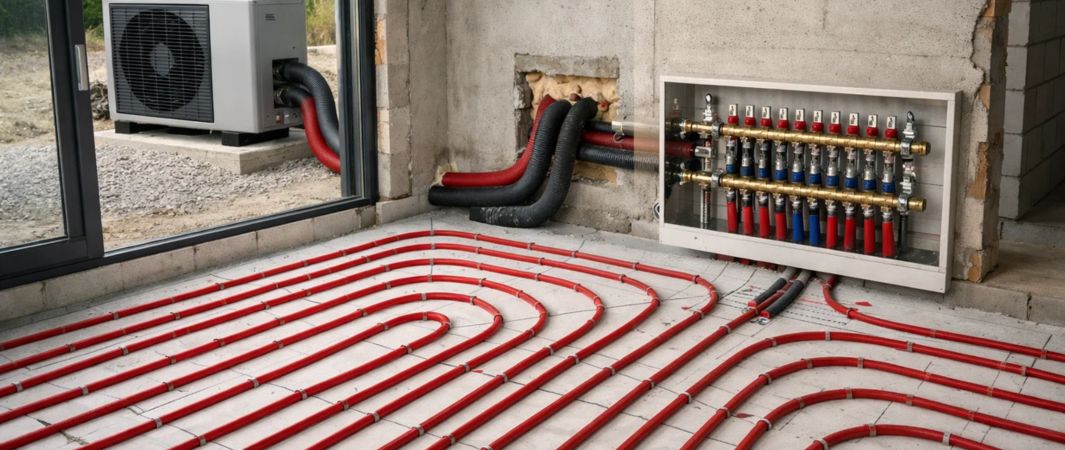
Heat pumps and underfloor heating are among the solutions that are very often combined into a single heating system. This is no coincidence. From both a practical and operational standpoint, these two technologies complement each other very well. If the system is properly designed, it can provide pleasant thermal comfort, even heating throughout the space, and more efficient operation throughout the entire heating season.
When it comes to this topic, many people ask, above all, whether a heat pump is suitable for underfloor heating or if it’s just one of several options. In practice, this is a very natural combination. However, that doesn’t mean you can simply choose any heat pump and everything will automatically work perfectly. The design of the entire system, the building’s specifications, and your expectations for the heating system are all important factors.
Why Are Heat Pumps and Radiant Floor Heating Often Combined?
Underfloor heating functions as a low-temperature heating system. This means that it does not require the same high temperature of heating water as traditional radiators to achieve thermal comfort. This is precisely where its great advantage lies when used in conjunction with a heat pump.
A heat pump works best when it does not have to heat water to an unnecessarily high temperature. If the system can heat effectively even at lower temperatures, operation is naturally more efficient. And underfloor heating is a prime example of such a solution.
Simply put, heat pumps and underfloor heating work well together because they operate on a similar principle. One system supplies heat at lower temperatures, and the other distributes it evenly and comfortably throughout the space.
A heat pump and underfloor heating provide even heat throughout the space
One of the things people appreciate most about underfloor heating is the way it distributes heat. Unlike heating with traditional radiators, it’s not just a localized heat source near the wall. The heat is distributed more evenly throughout the entire room.
In practice, this can result in:
- a more stable indoor temperature,
- a more comfortable feeling in the space,
- smaller temperature differences within the room,
- and more comfortable heating during normal daily use.
That is precisely why this combination is often used in new construction, but it can also make sense in renovations if the building’s structural design allows for it.
It’s not just important that the system works, but also how it works
When it comes to heating, it’s not enough for the system to simply provide the necessary heat. Equally important is how it performs during normal operation. This is where a heat pump and underfloor heating can offer an advantage, as they do not rely on sudden fluctuations.
Underfloor heating operates more quietly and evenly. A heat pump, when properly designed, does not need to operate in extreme modes. The result can be a system that operates not in bursts, but in a stable and natural manner.
This is particularly important in homes where long-term comfort is expected, not just rapid “heating up” of the space. This type of heating is therefore suitable for situations involving regular, year-round operation and an emphasis on comfort during everyday use.
The heat pump and underfloor heating must be properly designed
Although this is a very good combination, it does not mean that it will automatically work just as well in every building. The outcome depends on the project and the technical design. It is important to correctly determine the building’s heat loss, the heat pump’s capacity, and the parameters of the underfloor heating system itself.
The key factors are:
- the size and heat loss of the building,
- the composition of the floors and their suitability for heating,
- the division of heating zones,
- the control method,
- the heating water temperature settings,
- and the overall logic of the system’s operation.
If any of these factors are underestimated, the result may not be as good as it could be. The system will function, but comfort or efficiency may not meet expectations.
When does this combination make the most sense?
Heat pumps and underfloor heating are often particularly attractive options in cases where low-temperature heating is already being considered during the design phase of a building. They are therefore a natural fit for new construction. However, that doesn’t mean they can’t also make sense in renovation projects.
This is particularly practical when:
- the building is well insulated,
- a modern heating system is planned,
- a uniform room temperature is important,
- the investor wants a long-term, comfortable solution,
- the system needs to be logical from the perspective of future operation.
For older buildings, suitability depends more on the specific condition of the structure and on what the renovation can realistically achieve. Even in such cases, however, a sensible solution can be designed if the project is approached professionally.
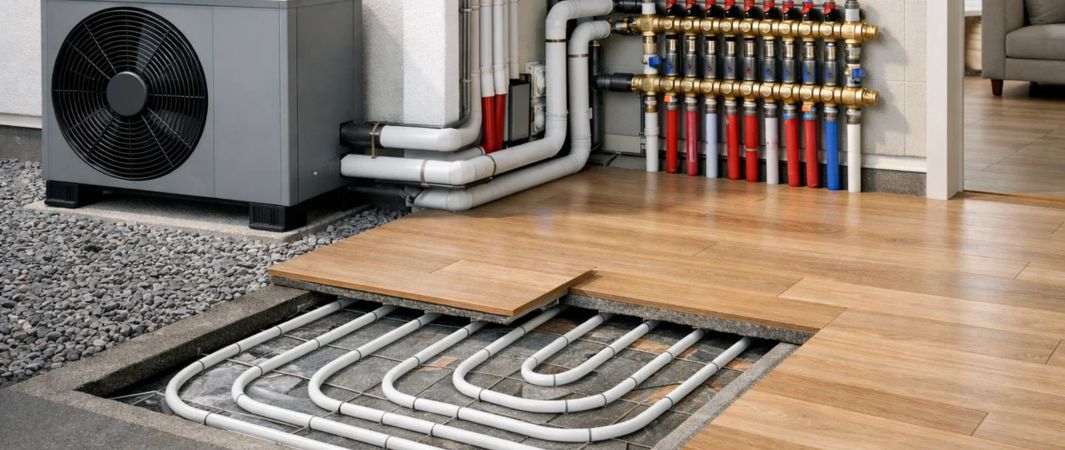
Regulation also plays a major role
With this combination, it’s not just the choice of equipment that matters, but also how the system will be controlled. Underfloor heating has different dynamics than radiators, so it’s important that the control system is tailored to how the system behaves.
Proper settings can help:
- maintain a stable temperature,
- avoid unnecessary fluctuations,
- manage individual zones more effectively,
- and utilize the heat pump’s potential more naturally.
Here, too, it becomes clear that a high-quality result comes not just from choosing the right equipment, but from a well-thought-out system as a whole.
Things to Consider Before Making a Decision
If you’re deciding whether a heat pump and underfloor heating are suitable for your project, it helps to ask yourself a few basic questions:
- Is the building suitable for low-temperature heating?
- Is it a new construction or a renovation?
- What is the building’s heat loss?
- What are your expectations regarding comfort and operation?
- and should the heating system be part of a broader technological solution?
The answers to these questions will tell you more than the general statement that a heat pump is suitable for underfloor heating.
Conclusion
A heat pump and underfloor heating are a very natural combination, as both systems operate efficiently at lower heating water temperatures and, together, can provide even and comfortable heating. If the system is properly designed, it can deliver excellent results not only on paper but also in everyday use.
With this combination, however, the entire system design is important—not just the choice of heat pump itself. The building, heat loss, floor construction, and control method are all decisive factors. At Slovklime, they can help you assess whether a heat pump and underfloor heating are suitable for your specific project and design a solution that makes sense both technically and operationally.
