 info@slovklima.sk
Heat Pump Noise: What Affects It and What to Look for When Choosing One

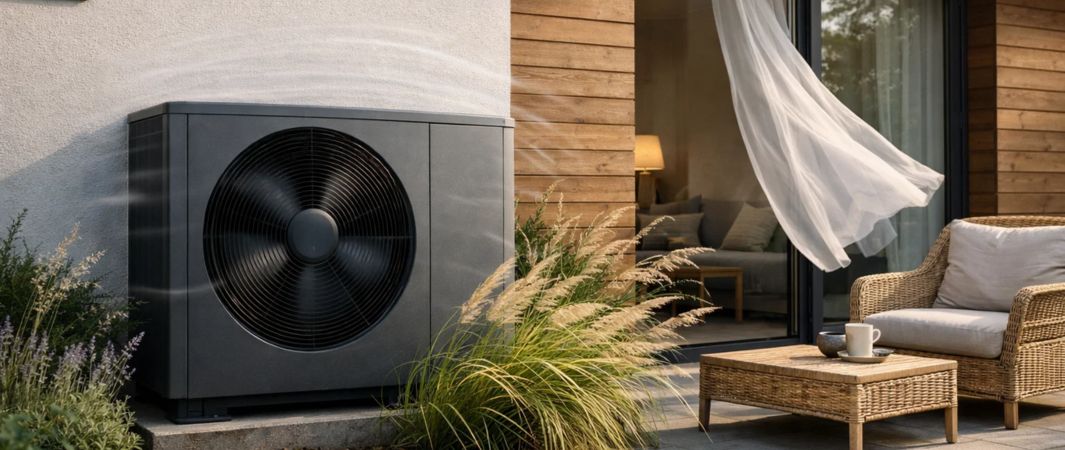
Heat pump noise is one of those topics that people often don’t start considering until after they’ve already chosen a specific model or brand. In practice, however, it’s one of the things worth thinking about much earlier. After all, a heat pump shouldn’t just operate efficiently—it should also be comfortable to use over the long term, both for you and those around you.
Mnohí si pod hlučnosťou predstavia len zvuk vonkajšej jednotky. V skutočnosti je situácia trochu širšia. Rozhoduje nielen samotná technológia, ale aj výkon zariadenia, spôsob regulácie, umiestnenie jednotky, kvalita montáže a to, ako je celý systém navrhnutý. Práve preto sa oplatí pozerať sa na hlučnosť tepelného čerpadla komplexne, nie len podľa jedného čísla v technickom liste.
Hlučnosť tepelného čerpadla neovplyvňuje len samotný model
Keď sa pri výbere porovnávajú jednotlivé zariadenia, ľudia sa často pozerajú najmä na výkon, spotrebu alebo cenu. Hlučnosť tepelného čerpadla býva až niekde v ďalšom kroku. Lenže práve tu sa môže ukázať rozdiel medzi riešením, ktoré bude v bežnej prevádzke príjemné, a riešením, ktoré bude zbytočne rušiť.
Na výsledný akustický prejav vplýva viac faktorov naraz:
- konštrukcia zariadenia,
- typ kompresora a ventilátora,
- spôsob regulácie výkonu,
- výkonová veľkosť jednotky,
- miesto osadenia,
- kvalita montáže,
- prenos vibrácií do konštrukcie objektu.
This means that even two units with similar performance may behave differently in actual operation. The decibel rating isn’t always the deciding factor. It’s also important to consider how the pump behaves during normal operation, under higher loads, or in night mode.
What You Should Actually Look for in Terms of Noise
With a heat pump, the outdoor unit is usually the main concern, as it tends to be the most significant source of noise. It contains a fan, a compressor, and other components that naturally make noise during operation. However, noise should not be perceived as a single “sound,” but rather as a combination of several factors.
In practice, these may include, for example:
- the fan running,
- the sound of the compressor,
- a change in intensity at higher power settings,
- vibrations transmitted to the floor or walls,
- the subjective perception of sound at night or in a quieter environment.
This is precisely why a unit that appears quiet on paper may be more disruptive in an unsuitable location than another solution with similar specifications.
Heat Pump Noise Level and Unit Placement
One of the most important factors is where the outdoor unit will be installed. Even a high-quality unit can be a nuisance if placed in the wrong spot. Conversely, a well-designed installation can significantly improve the overall acoustic experience.
The following factors most often make a difference:
- the distance from windows and the patio,
- proximity to a bedroom or relaxation area,
- the direction in which air and sound travel,
- installation against a solid wall or in a corner,
- the type of surface and mounting method.
If the unit is installed too close to where you normally spend time, or if sound reflects off surrounding surfaces, the noise level may subjectively seem higher than you would expect. That is precisely why it is not enough to consider only the unit’s performance. Equally important is where it will actually be used.
The quality of installation also plays a major role
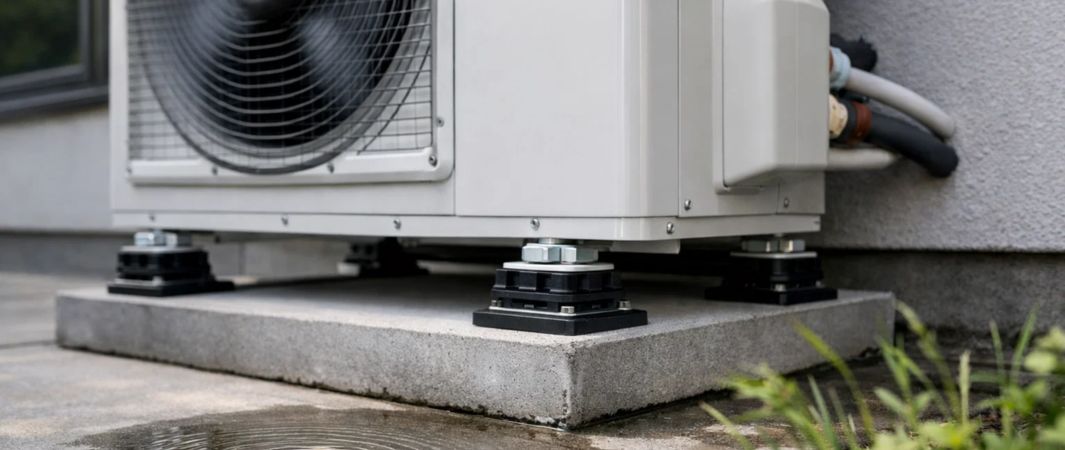
Installation is often underestimated when it comes to noise levels. People naturally focus primarily on choosing a heat pump, but the installation itself can significantly affect the outcome. If the unit is not installed correctly, vibrations can be transmitted to the wall, the foundation, or the metal mounting brackets.
This can then manifest as:
- resonance,
- unpleasant rumbling,
- vibrations felt indoors,
- reduced subjective comfort.
High-quality installation therefore means not only connecting the system correctly, but also carefully addressing the support structure, anti-vibration elements, and technical details surrounding the unit’s mounting. This is precisely where it becomes clear that a heat pump’s noise level is not just a product characteristic, but also the result of proper technical design.
The lowest number in the table isn’t always the deciding factor
When comparing units, people often focus on the decibel rating and automatically assume that a lower number means a better choice. While this figure is important, it shouldn’t be the only criterion. What also matters is the operating mode under which the value is specified and how the unit performs outside of ideal conditions.
It is important to distinguish, in particular, between acoustic power and sound pressure level. Acoustic power expresses the actual noise level of the device as a sound source, regardless of where you are standing. Sound pressure level, on the other hand, indicates the intensity of the sound measured at a specific location and at a certain distance from the device. For outdoor units, the value may therefore be measured, for example, several meters away from the unit, while for indoor units, it is usually measured closer to the device.
For the average user, this means that two values expressed in decibels may not refer to the same thing. When comparing the noise levels of heat pumps, it’s always a good idea to check whether the value refers to sound power or sound pressure level, and under what conditions the value was measured.
It’s also important to consider:
- sound power and sound pressure,
- operation under partial load,
- performance at higher output,
- the availability of a night mode,
- overall sound character.
In practice, there may also be a difference depending on whether the unit has smoother power regulation or operates more noticeably in surge modes. Some heat pumps operate more quietly during normal operation, partly because they do not need to change their operating intensity so frequently.
When Is a Heat Pump’s Noise Level Most Important?
Not every property has the same conditions. In some cases, noise level may not be a major concern, while in others it plays a very important role right from the design phase. This is especially true in the following situations:
- if the property is on a smaller lot,
- if the unit is close to a neighboring lot,
- if bedrooms or relaxation rooms are nearby,
- If the goal is to create a quiet environment free of typical urban noise,
- if the system is expected to operate frequently year-round.
In such cases, it pays to give this issue more attention right from the design phase. The sooner the noise level of the heat pump is taken into account, the easier it is to avoid unnecessary compromises.
How to Use Practical Questions to Guide Your Choice
If you want to make this process easier, it helps to ask yourself a few basic questions:
- Where will the outdoor unit be located?
- Is there a patio, bedroom, or neighboring property nearby?
- Will the unit run intensively at night as well?
- Is quiet operation a priority, or is performance more important?
- Is the design intended to minimize vibrations and sound reflections?
These questions often reveal more than the technical specifications alone. They help translate the issue of noise from theory to the specific space where the unit will actually operate.
Conclusion
The noise level of a heat pump is not a detail that should be addressed only at the very end of the selection process. It significantly affects user comfort and can determine how you perceive the entire system during everyday operation. However, it does not depend solely on the unit itself. Equally important are the unit’s location, the quality of installation, the control method, and the overall system design.
If you want a heat pump that will operate efficiently without causing unnecessary disturbance, it’s worth considering noise levels in a broader context. At Slovklime, they can help you consider not only performance and technical specifications, but also how the system will function in a specific space in terms of comfort and operation.

FAQ
Noise levels are influenced by the unit’s design, the type of compressor and fan, power control, the unit’s location, the quality of installation, and vibration transmission.
Decibels are important, but it is also necessary to distinguish between acoustic power, sound pressure, operating mode, and the device’s behavior at higher power levels.
A suitable location is one that is farther away from the bedroom, the patio, or a neighboring property, with good airflow and no unnecessary sound reflection.
Improper installation can cause vibrations, resonance, or rumbling. Therefore, anti-vibration mounts and proper mounting of the unit are important.
This is especially true for smaller lots, when neighbors are nearby, in bedrooms, in relaxation areas, or when the system is in use year-round.
It is necessary to evaluate not only the technical specifications, but also the unit’s location, night mode, power control, installation, and the overall design of the solution.