 info@slovklima.sk
Air Conditioning Vacuum Pump: Why It’s Important During Installation and Maintenance

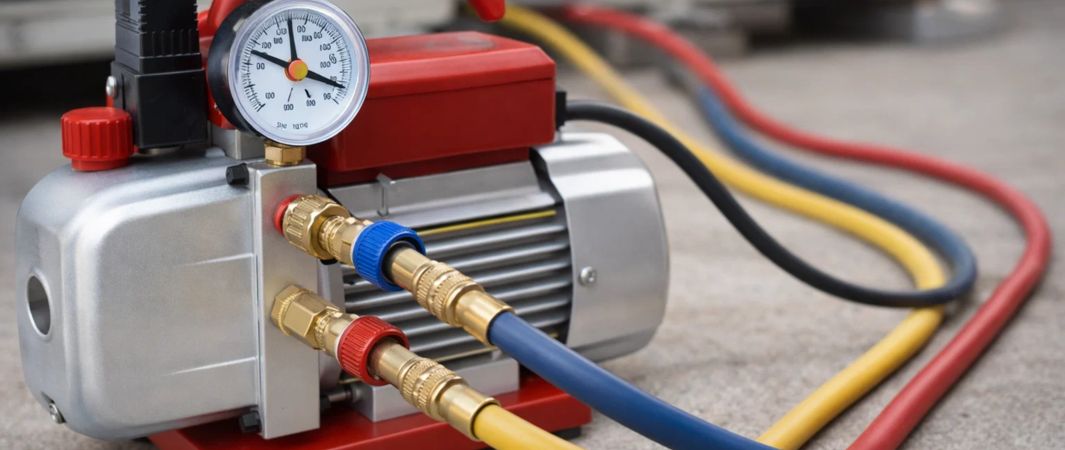
When installing an air conditioning system, many people focus primarily on the unit, its capacity, or the brand of the equipment. In practice, however, work procedures and tools are also crucial, and a high-quality installation cannot be achieved without them. One such tool is a vacuum pump for air conditioning. This is a tool used to evacuate the refrigeration circuit—that is, to remove air and moisture from the system before it is put into operation. Air conditioning manufacturers typically state in their installation manuals that the system must be evacuated using a vacuum pump and pressure gauges before startup to remove non-condensable gases and moisture from the circuit.
This is also important because an air conditioning system is not just a collection of mechanically interconnected parts. If moisture or air remains in the circuit, it can negatively affect the system’s efficiency, operating pressures, and long-term reliability. That is precisely why a vacuum pump for air conditioning is not considered an optional accessory, but rather an essential tool for professional installation and service. According to installation manuals, evacuation is performed during the initial installation, as well as whenever the system has been opened or relocated.
What a vacuum pump for air conditioning does
The purpose of a vacuum pump is to create a vacuum in the system and help remove air and moisture from the refrigeration circuit. This is important in air conditioning because the refrigerant circuit is designed to operate under precisely defined conditions. If unwanted gases or moisture remain in the circuit, the system may not function as intended.
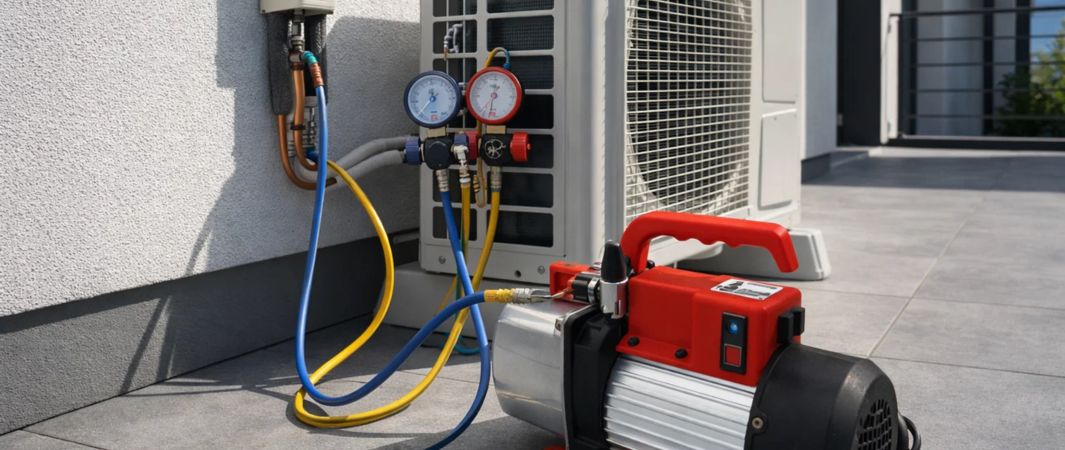
From a practical standpoint, this means that the vacuum pump for the air conditioning system is used after the indoor and outdoor units have been connected, but before the system is actually put into operation. The technician connects it via the service ports and a pressure gauge set to verify that the evacuation was performed correctly. Installation manuals repeatedly state that a vacuum pump—not the refrigerant from the unit—must be used before starting the system, and that the goal is to prepare the circuit for proper operation.
Why is it not enough to simply plug in and start the air conditioner?
At first glance, it may seem that once the copper pipes are connected and the electrical wiring is complete, the air conditioner is ready to start up. However, this is precisely where one of the most common mistakes in unprofessional installation tends to occur. The wiring alone is not enough. The refrigerant circuit must be prepared so that no air or moisture remains inside it.
If this step is overlooked, the system may begin to cool, but that does not necessarily mean it is functioning properly. Moisture in the circuit can have a negative impact on the system’s internal components, and non-condensable gases can affect the unit’s operational behavior. This is why technical manuals emphasize that evacuation is a standard part of air conditioning installation and that it must be performed correctly, using the appropriate equipment and verifying the results.
Vacuum Pump for Air Conditioning and Proper Work Procedure
A vacuum pump alone is not enough. How it is used is also important. When installing an air conditioning system, the entire work procedure matters, not just turning on the pump itself. First, check that the lines are properly connected and that the system is ready for evacuation. Next, the vacuum pump is connected to the service port via a gauge set, and the system is evacuated for a period of time corresponding to the length of the lines, the circuit volume, and the pump’s specifications. Installation manuals typically also provide approximate evacuation times or target vacuum levels.
It is also important to check the results. In professional practice, we don’t just monitor whether the pump has run for a certain number of minutes, but also what vacuum level has been achieved in the system and whether the system maintains the vacuum. This is what indicates whether the circuit is airtight and ready for the next step. For this reason, too, when it comes to the quality of installation, it’s not worth simplifying the procedure to merely “pumping out the air.” With air conditioning systems, the goal is to prepare the system so that it operates stably and without unnecessary problems.
Not all air conditioning vacuum pumps are the same
When selecting tools, it’s also important to consider how often they’ll be used and what types of systems they’ll be used to service. A technician working on standard split-system air conditioners needs a different vacuum pump than one who regularly works with larger refrigeration systems. The differences can lie in performance, design, durability, and how quickly and efficiently the pump can create the necessary vacuum.
When making a selection, it therefore makes sense to focus primarily on:
- the pump’s capacity,
- suitability for the specific type of work,
- build quality and serviceability,
- compatibility with the refrigerant and equipment used,
- whether the solution is intended for occasional service or daily professional installation.
At the same time, technical sources note that the equipment used during installation must be in good condition and suitable for the specific system and refrigerant. It is therefore not enough to simply have a vacuum pump. It is important that it be used correctly, maintained properly, and suitable for the specific application.
What to Keep in Mind When Using a Vacuum Pump
When working with a vacuum pump, it’s not just the device’s performance that matters, but also the details surrounding it. In professional practice, for example, factors such as the condition of the oil in the vacuum pump, the quality of the hoses, proper connection via service ports, and where the actual system status is measured are all taken into account. When evacuating an air conditioning system, it’s not enough to measure only what’s happening at the pump. It is important to know what is happening in the circuit itself. Practical technical guides therefore recommend ensuring accurate measurements, minimizing unnecessary bottlenecks in the connections, and maintaining a clean, organized workflow.
This is especially important because, with air conditioning systems, errors in the evacuation process often do not become apparent immediately. The unit may operate for a while after installation, but problems may not surface until later. That is why it is better to perform the evacuation thoroughly right from the start than to deal with the consequences of an inaccurate procedure later on.
Why a professional should use a vacuum pump for air conditioning
Although the principle itself is not complicated, the proper use of a vacuum pump is best left to a professional. Installing an air conditioning system is not just about mechanically connecting the pipes. It also involves working with the refrigerant circuit, checking for leaks, evacuating the system, and subsequently putting it into operation. Each of these steps is important and they are all interconnected.
An experienced technician can assess how long the evacuation should take, what result needs to be achieved, whether the system is maintaining a vacuum, and whether it is ready for the next step. At the same time, they have the right tools and know how to avoid mistakes that could later result in reduced performance or a malfunction. When it comes to air conditioning systems, therefore, it’s not worth treating the vacuuming process as a minor detail. It is one of the key components of a high-quality installation.
Conclusion
A vacuum pump for air conditioning is an important tool for both installation and service, as it helps prepare the refrigerant circuit for proper operation. Its purpose is to remove air and moisture from the system—elements that can later negatively affect the system’s efficiency and reliability. When it comes to air conditioning systems, this is not a minor detail but a standard part of professional practice.
If you want your air conditioner to operate reliably and without unnecessary problems, simply plugging it in isn’t enough. Proper system evacuation and high-quality tools for performing this step are just as important. At Slovklime, they can help you not only with selecting an air conditioning solution, but also with a professional approach to installation and service, where the air conditioning vacuum pump plays an essential role.

FAQ
The vacuum pump creates a vacuum in the cooling circuit and removes air and moisture from the system.
It is used after connecting the indoor and outdoor units, but before the air conditioner is actually put into operation.
If air or moisture remains in the circuit, it can impair the efficiency, operating pressures, and long-term reliability of the equipment.
The proper procedure requires the use of a vacuum pump; do not use refrigerant to purge air from the unit.
Purging is necessary during initial installation, as well as whenever the system has been opened, serviced, or relocated.
Without it, it is impossible to properly prepare the refrigerant circuit for safe, efficient, and reliable operation of the air conditioning system.