 info@slovklima.sk
Which Air Conditioner Brand? Pros and Cons of Well-Known Brands


Which air conditioner brand should you choose? An air conditioner brand is about more than just the logo on the unit. It determines how the unit will perform after five seasons, how quickly replacement parts can be obtained, and how much the first service visit will cost. When choosing a brand, it’s not enough to look only at performance and price—what matters is real-world experience, the availability of support, and reliability under both normal and intensive use.
Not all air conditioners are the same—and that applies not only to performance and features, but especially to what will happen to them in a few years. In some cases, filter issues need to be addressed every season; in others, it’s common to have to recharge the refrigerant after 5 to 6 years. The choice of brand often determines whether an air conditioner runs smoothly or ends up in the repair shop on a regular basis. This article doesn’t compare logos. Instead, it looks at brands as technicians see them—through the lens of long-term reliability, serviceability, and real-world field experience.
Which air conditioning brand to choose and what to focus on when making your selection
Comparing performance, noise levels, or design isn’t enough. The real difference between brands often only becomes apparent after several seasons. Some devices operate reliably for many years, while others require more frequent servicing, more intensive maintenance, or specialized repairs.
Here are some factors to consider when choosing an air conditioning brand:
- Availability of replacement parts
Not all brands keep parts for older models in stock. Sometimes you have to wait days, other times weeks—and the repair ends up costing more or getting delayed.
- Clear Documentation and Technical Support
A quality manufacturer provides schematics, manuals, and support. In practice, this means faster installation, easier maintenance, and fewer complications during repairs.
- Durability During Long-Term Use
Some units can handle even more demanding conditions (year-round operation, heating in winter, dusty environments) without any problems, while others cannot.
- Lifetime Costs
With some brands, service or component replacement can be expensive, or minor malfunctions occur more frequently, reducing both comfort and efficiency.
- Service Coverage in the Region
Not all brands have service partners available in every area. This is especially important in the case of emergency repairs.
The brand should be a guarantee that the appliance will operate reliably and without unnecessary problems—not just for the first season, but over the long term. When comparing specific models, the the information on the energy label, which provide information on the appliance’s energy efficiency, energy consumption, and noise level.
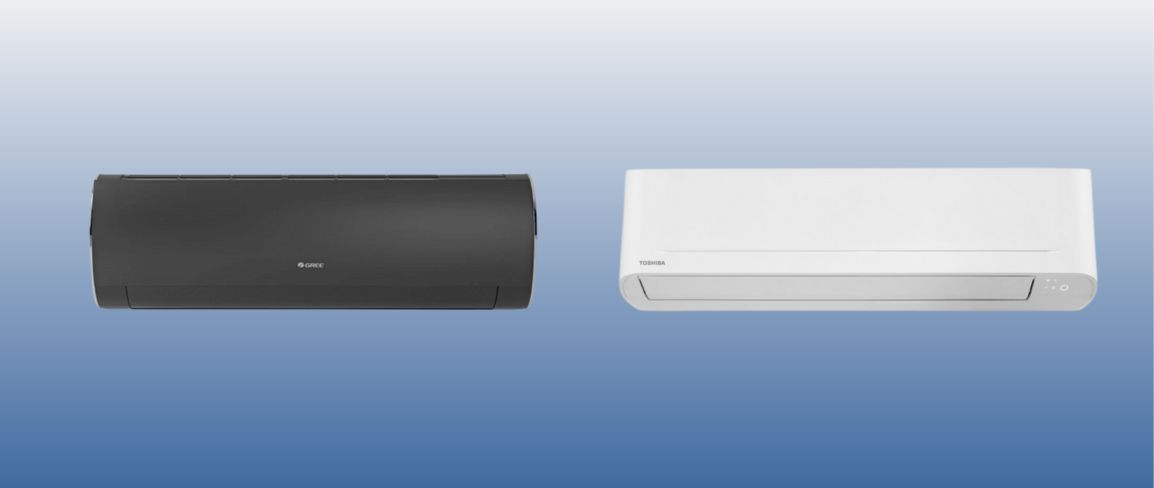
Comparison of Air Conditioner Brands: GREE, TOSHIBA, and AUX
GREE
Benefits:
- GREE is a leading global manufacturer of air conditioners with a history spanning more than 30 years.
- It offers a wide range of products—from simple split units to advanced multisplit and VRF systems.
- GREE units are known for their reliable operation, high-quality construction, and longer service life, even under heavy use.
- They often include premium features as standard (Wi-Fi, self-cleaning, I FEEL sensor).
Disadvantages:
- The higher purchase price of some models can be a deciding factor, especially for larger installations.
- A brand that’s less well-known to the average customer—its advantages are appreciated mainly by technicians and service partners.
TOSHIBA
Benefits:
- A brand with a very strong track record and a focus on developing its own technologies (e.g., inverter control, quiet operation, eco-friendly refrigerants).
- TOSHIBA air conditioners are particularly popular in interiors where quiet operation, precise control, and stable performance are important.
- Low operating costs and a long service life—especially in model series designed for continuous operation.
Disadvantages:
- Price-wise, it’s a more premium brand, which can be a barrier for those on a tighter budget.
- The somewhat conservative design of some models may be perceived as less attractive compared to newer brands.
AUX
Benefits:
- AUX is a rapidly growing brand with a focus on design and modern technology.
- Excellent value for the price—these devices are affordable but still offer features such as Wi-Fi control, automatic cleaning, and timers.
- A good choice for homes and smaller commercial spaces where you’re looking for a balance between functionality and budget.
Disadvantages:
- In some regions, it may be more difficult to find specialized service or parts for older models.
- Less widespread in the B2B segment compared to traditional brands—installation companies may not have as much experience with it.
In practice, what matters most is how the equipment performs over the years, how quickly it can be repaired, and what it can handle in real-world operation. GREE, TOSHIBA, and AUX offer various solutions—some are based on proven classics, while others bring modern technologies at an affordable price.
Which brand is “the right one” depends on the specific space, expectations, and what the user prioritizes—quiet operation, design, performance, service, or price. If the choice is made wisely, the air conditioner will serve you for years without any unnecessary worries.
| Brand | Key Benefits | Things to Consider |
|---|---|---|
| GREE | wide selection, reliable operation, high-quality construction, modern features | Higher purchase price for some models |
| TOSHIBA | Quiet operation, precise control, stable performance, long service life | higher price |
| AUX | Good price-to-performance ratio, modern features, more affordable price | In some regions, service or parts availability may be limited |
The brand alone isn’t enough. Why do installation and service matter, too?
Even the best air conditioning system can let you down if it’s installed incorrectly or isn’t properly maintained. Choosing a brand is just the first step—what really matters is who installs it and how they do it.
Improper installation of the indoor unit, loose connections, undersized piping, or incorrect condensate drainage can cause malfunctions as early as the first season. Equally important is access to service—if spare parts, documentation, or trained technicians aren’t available, a simple problem can drag on for weeks.
What makes an air conditioning system reliable isn’t just the logo on the outdoor unit, but also how it’s wired, configured, and regularly maintained. A quality service and installation partner can identify potential risks during the initial inspection, tailor the solution to the space, and take care of the system even after installation.
How to Choose a Brand in a Real-World Situation
When making a decision, a specific detail often tips the scales: one person might have an open space with large windows, while another needs a quiet unit for the bedroom. That’s why it makes sense to choose a brand and model based on real-world conditions, not just on a general comparison.
In practice, the decision-making process often looks like this: 2–3 brands are compared, service availability is checked, the expected duration of use during the season is estimated, and consideration is also given to who will be using the air conditioner. Sometimes performance is the priority, other times it’s design, and in other cases, ease of use. A sensible choice, therefore, doesn’t start with technical specifications, but with the question: What exactly do we need from this air conditioner?
Which Air Conditioner Brand: Conclusion
There is no one-size-fits-all answer to the question of which air conditioning brand to choose. The decision should always be based on the specific space, the user’s expectations, and the service options available in that location. The brand alone does not guarantee satisfaction—what matters is the quality of the unit’s design, installation, and maintenance.
On the Slovklima.sk website, you’ll find a selection of air conditioners from trusted brands and technical support to help you with both selection and installation.
When expert insight is combined with your actual needs, the result is a solution that won’t cause problems—neither on hot summer days nor years down the road. That’s exactly what it’s all about—quiet, reliable operation without unnecessary complications.

FAQ
The choice depends on the space, the desired level of comfort, the budget, the functional requirements, maintenance, and long-term reliability.
GREE offers a good balance of price and performance, TOSHIBA is among the more premium options, and AUX is an interesting, more affordable model with modern features.
GREE offers a good balance of price and performance, a wide selection of models, and practical solutions for both homes and commercial spaces.
TOSHIBA is among the more premium solutions, with an emphasis on quality, reliability, quiet operation, and greater user comfort.v
AUX may be a good choice for customers looking for a more affordable solution with modern features and a good price-to-performance ratio.
Other important factors include proper performance, professional installation, service, the availability of replacement parts, and the suitability of a specific model for a given space.