 info@slovklima.sk

Water-Cooled Fan Coil Unit: How It Works and Where It Is Used

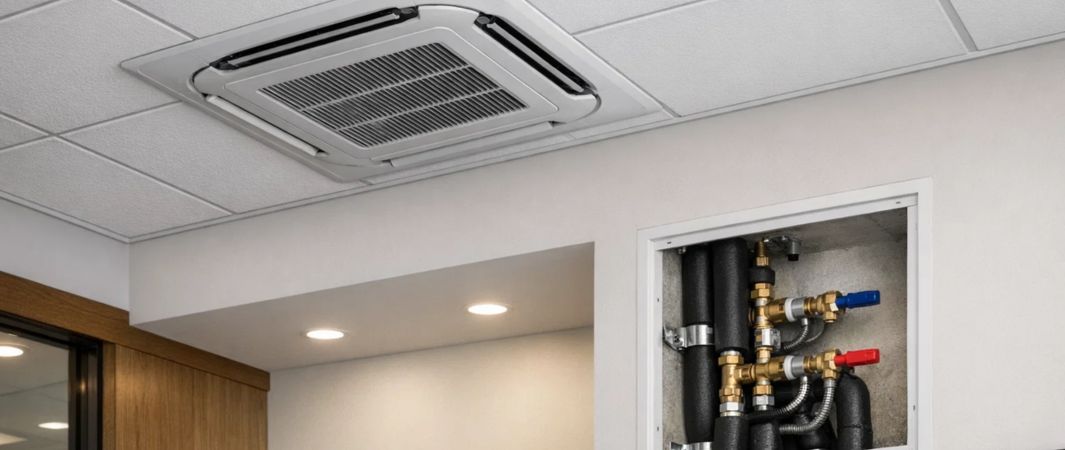
Water-based fan coils are among the solutions used in situations where efficient heating and cooling of a space via a water-based system is required. For many people, this is a less familiar concept than traditional air conditioning or a heat pump, but in practice, it can be a very interesting solution for homes, offices, and commercial spaces. That’s exactly why it’s worth knowing how a water-based fan coil unit works, where it’s used, and what’s important to consider when choosing one.
At first glance, a fan coil may look like an indoor air conditioning unit. In reality, however, it works differently. It is not directly connected to a refrigerant like a standard split-system air conditioner, but rather to a water loop. This means it operates using hot or chilled water supplied to the system by another source, such as a heat pump or a chiller. This is precisely where its main difference—and its main advantage—lies.
What Is a Water-Cooled Fan Coil Unit and How Does It Work?
A water-cooled fan coil is a device that transfers heat or cool air into a space using a heat exchanger and a fan. Water at a specific temperature flows through the unit, and the fan then blows air through the heat exchanger into the room. If the heat exchanger contains chilled water, the space is cooled. If the heat exchanger contains hot water, the space is heated.
Simply put, a water-based fan coil unit functions as the terminal component of a water-based system. It does not generate heat or cooling on its own. It needs to be connected to a source that supplies them. In practice, this means it is often combined with:
- a heat pump,
- a chiller,
- or another water-based heating or cooling source.
It’s important to understand this from the start. If someone expects a fan coil unit to be a standalone replacement for air conditioning without any additional technology, they’re not looking at the system correctly. A water-based fan coil unit is part of a solution, not a standalone source of heating or cooling.
A water-source fan coil unit is ideal for situations where you need both heating and cooling
One of the greatest advantages of a water-cooled fan coil unit is its versatility. A single unit can handle both winter and summer operation. This means that the same unit can heat in the winter and cool in the summer, provided the entire system is set up for it.
That’s why it can be particularly appealing in the following situations:
- when a single system is used for both heating and cooling,
- when the building is connected to an air-to-water heat pump,
- when a faster response time is important compared to underfloor heating,
- when comfort is expected throughout the different seasons without the need for two separate systems.
Compared to underfloor heating or cooling, a fan coil unit may offer the advantage of a faster response. The space can be heated or cooled more dynamically, which can be particularly practical in areas where conditions change throughout the day or where the space is not used continuously.
Where are water-cooled fan coils most commonly used?
Fan coils aren’t just used in office buildings or hotels, as some people think. Today, they can also be a practical choice for single-family homes, apartments, offices, medical clinics, or smaller commercial buildings.
From a practical standpoint, they may be particularly suitable where:
- a hydronic system has already been designed or is planned,
- the investor wants to combine heating and cooling into a single system,
- underfloor heating alone is not sufficient,
- faster room temperature control is needed,
- greater comfort is sought during transitional seasons.
The type of space itself also plays a major role. One solution may make sense in an open-plan office, another in a bedroom, yet another in an apartment, and still another in a more technically demanding facility. Therefore, a water-cooled fan coil unit is not chosen solely based on its appearance, but primarily based on what it is intended to provide in a specific space.
What is the difference between a fan coil unit and a conventional air conditioner?
This is a common question. At first glance, some solutions may seem similar, but they work on different principles. A traditional split-system air conditioner works directly with refrigerant, and the indoor unit is connected to the outdoor unit. A water-cooled fan coil unit works with water and is connected to a water-based heat or cooling source.
The difference, therefore, lies not only in the technology but also in the overall system design. Conventional air conditioning is typically a standalone solution. A water-cooled fan coil unit is usually part of a broader system, often in combination with a heat pump.
In practical terms, this means that a fan coil unit may be a good option in situations where:
- The heat pump issue is already being addressed,
- The investor does not want to combine multiple separate systems,
- it makes sense to use a water distribution system,
- a more technically integrated solution for the building is required.
What to Consider When Choosing
When making a selection, it’s not enough to simply know that you want a fan coil unit. It’s important to consider the entire system and the conditions of the building. That’s because several factors come into play at once.
The following are particularly important:
- What heat or cooling source will the fan coil unit be connected to,
- what capacity a specific space requires,
- whether the system is intended for cooling only, heating only, or both,
- where the unit will be located,
- what the noise level requirements are,
- how condensate drainage will be handled during cooling,
- what type of control is expected from the system.
A water-cooled fan coil unit is therefore not selected in isolation. For it to function properly, it must be correctly designed within the context of the entire building. This is also why, with this type of solution, it doesn’t pay to base your decision solely on price or on what looks good in a picture.
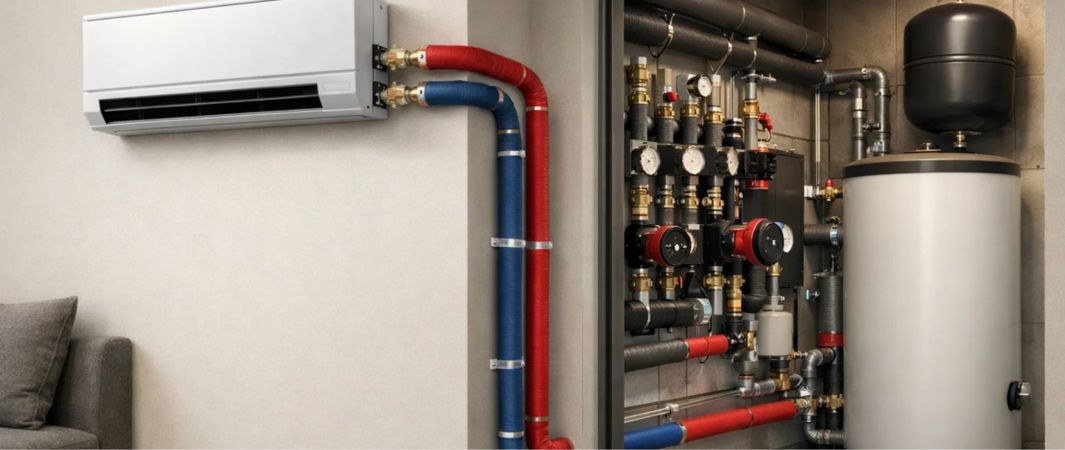
Water-cooled fan coil units and proper system design
With this type of solution, the project and technical design play a major role. It is not enough to simply mount the unit on a wall or under the ceiling. It is important that the capacity, location, water connection, control system, and overall operational logic are properly designed.
If any of these aspects are overlooked, it can lead to several problems:
- the space will not be cooled or heated evenly,
- the system will be noisier than necessary,
- operation will not be comfortable,
- the response to temperature changes will be slower,
- or the full potential of the solution will not be realized.
That is precisely why it makes sense to have a water-cooled fan coil unit designed by an expert who can look not only at the unit itself but also at the entire system surrounding it.
Conclusion
A water-based fan coil unit can be a very interesting solution when you want to combine heating and cooling into a single water-based system. It is not a standalone source of heat or cooling, but rather a terminal unit that, when properly designed, can provide a high level of comfort, flexibility, and a faster response to temperature changes in the space.
For such a solution to work well, it’s important to take a comprehensive approach. It’s not just the unit itself that matters, but also the power source, connections, controls, and the overall system design. At Slovklime, they can help you determine whether a water-cooled fan coil is right for your space and design a solution that makes sense both technically and operationally.
