 info@slovklima.sk
Chemical Products in Refrigeration Technology: Which Ones Are Essential?

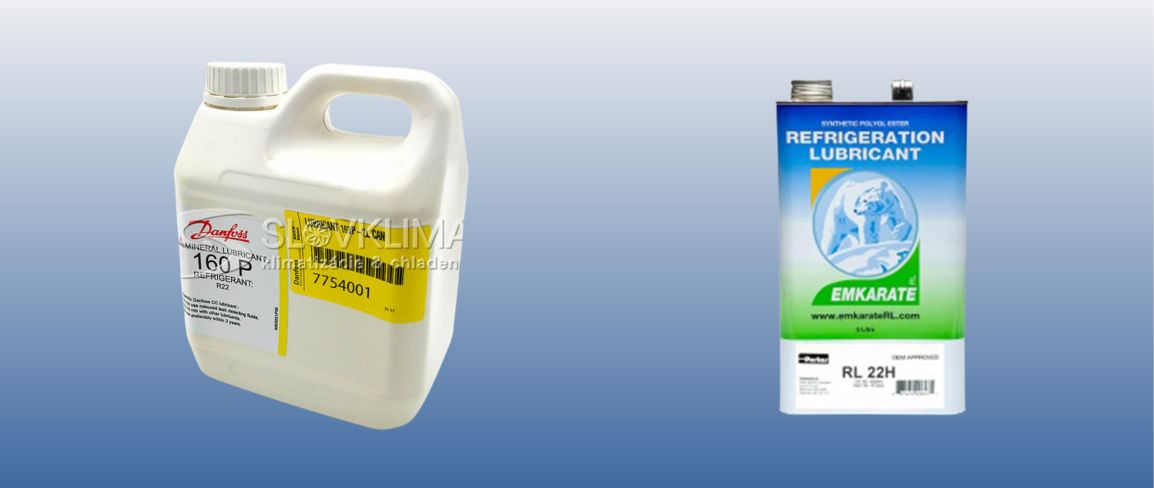
Chemical products play a key role in industrial refrigeration, which is an integral part of many industries—from the food industry to the pharmaceutical industry and the chemical sector. In these areas, precise temperature control is crucial for maintaining product quality, safety, and stability. However, for cooling systems to operate reliably under demanding conditions and withstand extreme temperature and pressure loads, they cannot function without these specific chemical products.
These products—ranging from refrigerants and lubricants to cleaning and protective agents—play a key role in the day-to-day operation, maintenance, and long-term service life of equipment. Let’s take a look at which chemical products are essential in refrigeration technology, what their properties are, and why their selection should not be underestimated.
Oils and Lubricants: Unassuming Yet Key Players in Refrigeration Technology
Among the often-overlooked yet extremely important refrigeration products are special oils and lubricants, which ensure the reliable operation of compressors and other moving parts in refrigeration systems. Their main function is to reduce friction, dissipate heat, and prevent wear on mechanical components, which directly affects the efficiency and service life of the entire refrigeration system.
In refrigeration technology, it is important that the lubricants used are compatible with the specific type of refrigerant and can withstand extreme temperatures, pressures, and chemical reactions. The right oil ensures not only smooth system operation but also stable, long-term performance without unnecessary downtime. High-quality oils and lubricants are thus a key link between efficient operation and failure prevention, and should therefore be part of every refrigeration equipment maintenance strategy. When selecting suitable refrigeration products, one should therefore never overlook this category—which may seem inconspicuous at first glance but is technically indispensable.
Types of Cooling Systems and Their Importance in the Chemical Industry
Industrial coolers are among the most widely used systems. Thanks to their high cooling capacity, environmentally friendly refrigerants, and modern control technologies, they can effectively cool reactors, heat exchangers, and entire production lines. Reactors with integrated cooling systems are used for even more precise temperature control during chemical reactions.
The basic types of cooling systems are air-cooled, liquid-cooled, and gas-cooled systems. The choice of a specific type of cooling system depends on the application’s requirements.
Ventilation cooling systems use air as the cooling medium. These are most commonly metal radiators, usually equipped with fans to increase airflow. They are mainly used for small, localized heat sources, such as control computers.
Liquid systems are mostly used in larger applications. The heat transfer medium consists of liquids. Water and glycol are the most commonly used media. Liquid cooling systems ensure efficient heat removal, primarily due to the medium’s high heat capacity. Water or a glycol mixture can effectively remove heat from the cooled areas and transfer it through heat exchangers for further use.
Gas refrigeration systems use compressed gas as a heat transfer medium. There is a relatively large variety of refrigerant gases available on the market. Each gas has its own specific characteristics and area of application. Therefore, it is usually not a problem to find the right one for a specific application.
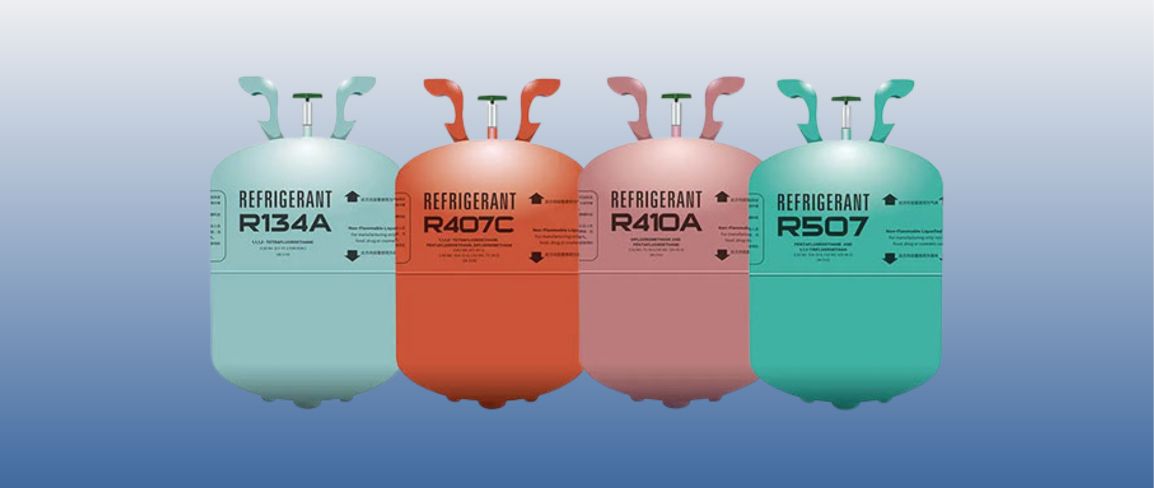
The Most Commonly Used Gaseous Refrigerants
R-134a
This is a gas that, until recently, was very commonly used, particularly in automotive air conditioning systems and and in home refrigerators. It has the advantage of being nonflammable and nontoxic, but its high global warming potential is a major problem. For this reason, it is now being replaced by more environmentally friendly alternatives in most new systems.
R-410A
This gas is used primarily in air conditioners and heat pumps. It is more efficient than some older gases and is a good heat transfer medium, but, like R-134a, it has a high global warming potential. Therefore, plans are in place to phase it out gradually in the future.
R-32
R-32 is a modern refrigerant that is more efficient and more environmentally friendly than R-410A because it has a lower impact on the climate. It is increasingly used in new air conditioning units and heat pumps. Its disadvantage is that it is slightly flammable, so it requires careful handling and appropriate technical solutions.
R-290 (propane)
This gas is a naturally occurring substance and is very environmentally friendly—it contributes almost nothing to global warming. It is used in household refrigerators and freezers, and increasingly in small heat pumps as well. However, it is highly flammable, which limits its use in larger systems where a leak could pose a risk of fire or explosion.
R-744 (carbon dioxide – CO₂)
Carbon dioxide can also serve as a refrigerant. It is completely harmless to the ozone layer and has a negligible impact on global warming. It is mainly used in supermarket refrigeration chains, bus air conditioning systems, and industrial systems. The problem, however, is that equipment using this gas must operate under very high pressure, which makes it more technically and financially demanding.
R-1234yf
This gas is a new-generation refrigerant with a very low global warming potential. It is used primarily in new cars today, where it replaces the older R-134a. It is slightly flammable, but in practice it has proven to be sufficiently safe when used properly.
The Importance of Service and Maintenance for the Reliable Operation of Cooling Systems
Even the most advanced cooling system cannot ensure long-term performance without regular maintenance. In an industrial environment where sensitive chemical products are processed, neglecting maintenance can lead to serious consequences. These range from costly equipment failures and unplanned downtime to damage to or complete spoilage of products. A reliable industrial refrigeration service provider is therefore a key partner for every facility operator.
Preventive maintenance involves more than just a routine inspection; it is a systematic check of the entire system’s functionality, including checking the refrigerant level and condition, the condition of electrical connections, cleaning the coils, and replacing worn-out parts. Regular inspections make it possible to identify potential risks before they escalate into serious technical problems. In the long term, this contributes not only to stable operation but also to the protection of sensitive chemical processes where precise temperature control is essential.
Chemical Products: Conclusion
Refrigeration technology requires highly specialized solutions, ranging from high-performance cooling systems to specialized chemical products (refrigerants) and reliable oils, lubricants, and preventive maintenance. Each of these elements plays a crucial role in ensuring the safe, efficient, and uninterrupted operation of the equipment. Choosing the right refrigeration products is therefore not just a matter of performance, but also of operational reliability and long-term cost savings.
If you’re looking for high-quality products and professional solutions for your refrigeration systems, visit Slovklima.sk, where you’ll find a wide range of proven products for industrial refrigeration.
