 info@slovklima.sk
Air Conditioning with Heat Recovery: Energy-Efficient Ventilation and Cooling in a Single System

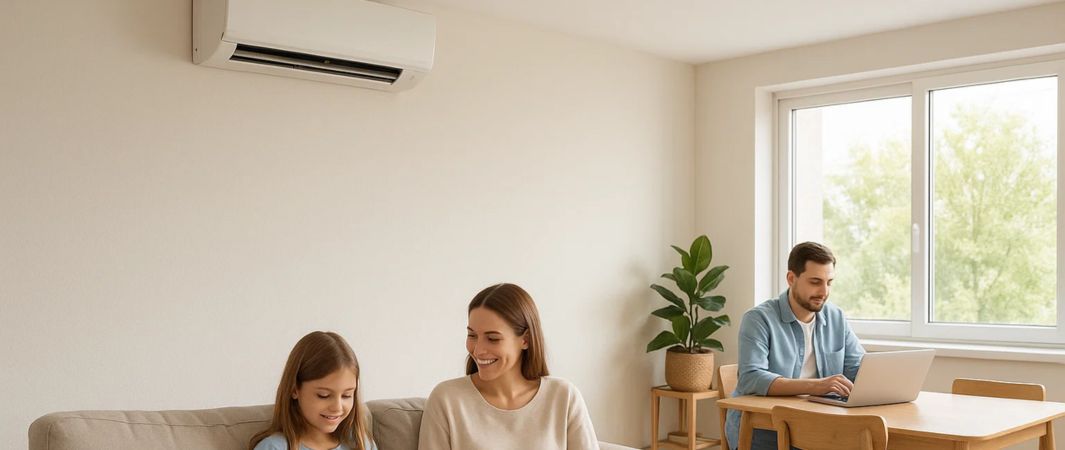
Air conditioning with heat recovery is the answer to the challenges posed by modern buildings, which feature high-quality thermal insulation and airtight windows. While this is beneficial in terms of energy savings, it also creates a new problem—without controlled ventilation, moisture, CO₂, and odors accumulate indoors. Air conditioning alone does not solve this problem, because most residential and small commercial systems circulate indoor air rather than bringing in fresh air from outside.
This involves integrating cooling (or heating) with controlled ventilation and heat recovery. Such a system can ensure a comfortable temperature and fresh air while minimizing heat loss during ventilation.
In the following sections, we’ll explain why it makes sense to consider this solution, what the difference is between air conditioning and heat recovery, what options are available for apartments, single-family homes, and small businesses, and what to keep in mind when designing the entire system.
Why Consider an Air Conditioning Solution with Heat Recovery
Combining air conditioning and heat recovery offers several key benefits:
- Indoor Air Quality
Heat recovery ensures a continuous supply of fresh air and the removal of stale air, moisture, and odors. Compared to window ventilation, the process is controlled, stable, and weather-independent.
- Energy Efficiency
The heat recovery unit transfers heat (in winter) or “coolness” (in summer) between exhaust air and fresh air. When properly designed, heat loss during ventilation is significantly reduced, and the air conditioning system does not have to compensate for unnecessary temperature differences.
- Comfort in Summer and Winter
The air conditioning system regulates the temperature (cooling or heating), while the ventilation system provides fresh air. Together, they create a stable and comfortable interior without “stuffy air” and without the need to open windows frequently.
- Hygiene and Health
Filtration of the incoming air helps trap dust, pollen, and smog particles. Combined with appropriate humidity and temperature, the environment is more pleasant even for people with allergies and those with sensitivities.
- Future-Oriented Operation
The trend toward stricter energy efficiency requirements for buildings is shifting controlled ventilation and efficient cooling from a “luxury” to a standard feature of modern single-family homes and small businesses.
How Heat Recovery Works and Why Air Conditioning Cannot Replace It
A common misconception is the idea that if a building has air conditioning, there’s “no need to ventilate” or that air conditioning alone ensures a supply of fresh air. In practice, however, most wall-mounted and cassette air conditioning units operate using indoor air —they draw it in, cool (or heat) it, and return it to the room.
Heat recoveryventilation works differently:
- the heat recovery unit extracts stale air from the interior (kitchen, bathroom, hallways),
- while simultaneously bringing in fresh air from outside (into living rooms, bedrooms, and offices),
- in the heat exchanger, energy is transferred from the exhaust air to the fresh supply air,
- Air exchange takes place continuously and in a controlled manner—based on the selected mode or sensor readings (CO₂, humidity).
Air conditioning thus regulates temperature, while heat recovery ensures air freshness and quality. It is only when these two functions are combined that a complete comfort solution is achieved in modern buildings.
Air Conditioning with Heat Recovery vs. Standalone Air Conditioning
When designing a technical solution, you’ll most commonly encounter three scenarios in practice:
Air conditioning only, without heat recovery
The most common solution in older apartments and smaller offices—a wall-mounted air conditioning unit in the living room or office. Advantages:
- relatively low initial investment,
- simple installation,
- quick improvement in thermal comfort in the summer.
The disadvantage is:
- no or minimal fresh air intake,
- the need to ventilate through windows, which reduces cooling efficiency,
- The risk of increased humidity and CO₂ buildup in airtight buildings.
Separate heat recovery unit + air conditioning
A common solution in new construction or high-quality renovations:
- a central heat recovery unit with air distribution throughout the house or apartment,
- Independent air conditioning (multi-split, VRF, fan-coil system).
Benefits:
- optimal ventilation and good air quality,
- flexible cooling solutions tailored to the needs of individual rooms,
- the option of phased implementation (heat recovery first, air conditioning later).
It is important that the design of both systems be coordinated —in terms of outlet placement, airflow direction, noise levels, and control.
Air Handling Unit with Heat Recovery and Cooling
Central air handling units are used primarily in office buildings, industrial facilities, or larger structures; they:
- provide ventilation with heat recovery,
- include a cooler (connected to a cooling circuit or chilled water),
- can simultaneously ventilate and cool multiple zones.
This solution enables a fully integrated system, but requires a detailed design, space for the technology, and thorough coordination with the construction team.
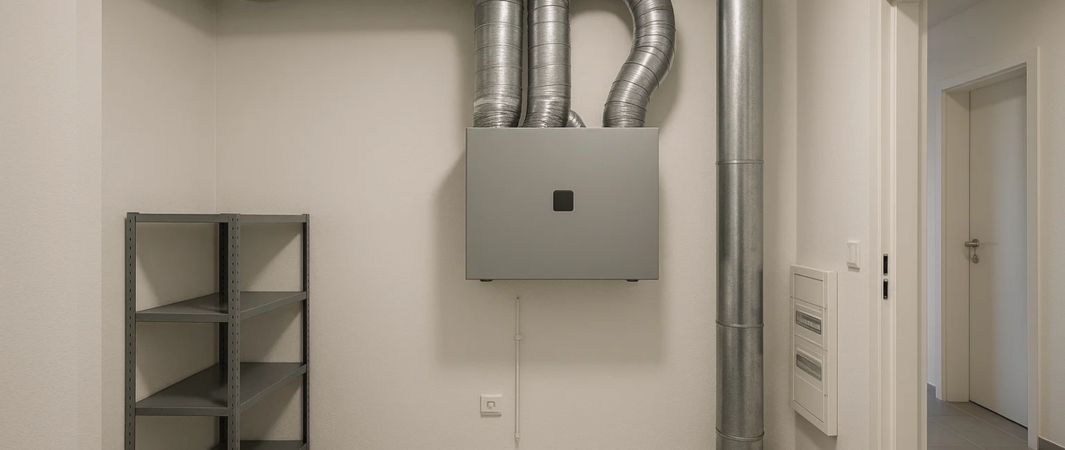
Options for implementing air conditioning with heat recovery in apartments and single-family homes
Air conditioning with heat recovery can be designed in various ways depending on the type of building, the scope of the renovation, and the budget.
New Construction with Planned Controlled Ventilation
In new single-family homes, it is ideal to incorporate heat recovery into the design from the outset:
- a central heat recovery unit is designed with ductwork extending to all living spaces,
- intake and exhaust grilles are appropriately positioned,
- Air conditioning units (e.g., in the bedroom, living room) or fan coils connected to a central cooling source can be installed in living spaces.
The advantage is that air ducts, chilled water pipes, and copper lines can be concealed in ceilings, shafts, and partitions during the structural phase of construction. The result is a comfortable and aesthetically pleasing system.
Apartment Renovation Without Major Construction Work
In existing apartments, the options for central heat recovery systems are often limited. Possible solutions include:
- decentralized heat recovery units (local units installed in exterior walls, e.g., in the bedroom or living room),
- a wall-mounted air conditioning unit in the main living area,
- or a multi-split system for multiple rooms.
In this case as well, it is important that the airflow from the air conditioner and the heat recovery units do not conflict with each other —the goal is comfortable airflow, not a draft coming from two directions.
Smaller Businesses and Offices
In smaller offices and business premises, a common setup is:
- one or more indoor air conditioning units (wall-mounted, cassette-type),
- supplemented by central or local ventilation with heat recovery.
When designing the system, it is important to consider:
- fresh air requirements based on the number of people,
- workstation layout (so that no one is sitting in a direct airflow),
- acoustics—noise levels from fans, heat recovery units, and air conditioning.
What to Consider When Designing an Air Conditioning System with Heat Recovery
For an air conditioning system with heat recovery to operate reliably and comfortably, it is important to pay attention to several key areas.
Calculating ventilation and cooling requirements
The basis is:
- assessing the building’s heat load (glazed areas, orientation, insulation, internal heat sources),
- determining the required fresh air supply based on the number of occupants and the nature of the spaces,
- designing the capacity of the air conditioning system (or central cooling source) and the heat recovery parameters.
Only then will the equipment be properly sized, and the system will not be uncomfortable in practice (undersized cooling, insufficient ventilation) or unnecessarily oversized.
Placement of Air Outlets, Grilles, and Units
For comfort and quiet operation, it is essential to:
- the placement of the supply and return vents for heat recovery (to ensure that the air in the room is well mixed),
- positioning indoor air conditioning units so that the air does not blow directly on people,
- Coordination with furniture, suspended ceilings, and other interior elements.
An inappropriate design can lead to undesirable effects—drafts, noise, localized cold “zones,” or, conversely, areas with insufficient cooling.
Noise and Acoustic Comfort
An air conditioning system with heat recovery has more fans and moving parts. Therefore, when designing the system, it is important to:
- select equipment with appropriate sound power levels,
- design the air distribution system with airflow velocities in mind (excessively high velocities = noise),
- properly locate the units in a mechanical room or in a space so that they do not cause disturbance (e.g., in bedrooms at night).
Filtration and Maintenance
Both heat recovery and air conditioning require regular maintenance:
- inspection and replacement of filter cartridges (especially in the outdoor air intake),
- cleaning of heat exchangers and internal surfaces,
- regular inspections and checks of control settings.
Accessibility should also be considered during the design phase—so that filters and maintenance-accessible parts can be easily inspected and replaced.
Common Mistakes When Combining Air Conditioning and Heat Recovery
In practice, certain mistakes are commonly made when implementing a combined system:
- design inconsistencies — air conditioning and heat recovery are addressed separately, without coordination, leading to suboptimal airflow,
- inappropriate placement of vents—the heat recovery intake and the air conditioning exhaust can create local drafts,
- Under-sized heat recovery system—the system does provide ventilation, but it is insufficient for actual operation,
- neglected maintenance – clogged filters reduce efficiency and degrade air quality,
- Inadequate assessment of noise levels—in bedrooms or offices, the system then disturbs occupants.
This is precisely why it is important to view air conditioning and heat recovery not as two separate elements, but as a single functional unit that must be designed and configured as a system.
Conclusion
Air conditioning with heat recovery is a modern solution for apartments, single-family homes, and smaller commercial spaces where comfort, indoor air quality, and energy efficiency are priorities. Air conditioning alone ensures a comfortable temperature, but without controlled ventilation and heat recovery, the system’s comfort and energy efficiency are limited.
When designing an air conditioning system with heat recovery, it is important to base the design on the building’s actual needs, properly size the ventilation and cooling systems, carefully consider the placement of units and vents, and not overlook noise levels and maintenance. This approach can result in a solution that provides fresh air, a stable temperature, and energy-efficient operation all in one system.
If you’re considering a similar solution for your apartment, family home, or business, it’s worth turning to a professional partner who understands the design of air conditioning and heat recovery systems, as well as how to integrate them effectively under specific conditions—from the initial assessment through commissioning and long-term maintenance.
