 info@slovklima.sk
Where to place the air conditioner in the apartment and house to make it work best?


Air conditioning is now a common feature in modern apartments and single-family homes. However, whether it actually provides comfort, energy savings, and quiet operation depends on more than just the choice of brand and capacity. Equally important is where to install the air conditioning—both indoors and outdoors.
A properly chosen location helps distribute air evenly, minimize drafts, reduce noise, and prevent unnecessary strain on the unit. In the following sections, we’ll look at the basic principles of air conditioner placement in apartments and homes, as well as practical recommendations for both indoor and outdoor units.
Why the Location of an Air Conditioner in an Apartment or House Matters
The placement of an air conditioner directly affects:
- room comfort—whether you’ll feel a pleasant coolness or an unpleasant draft and a “chill down your neck,”
- temperature uniformity—whether some parts of the room will be too cold and others barely cooled,
- energy consumption—if the air conditioner draws in and blows air inefficiently, it must run at a higher power setting and for longer periods,
- noise level—incorrect placement can amplify noise inside or disturb neighbors outside,
- equipment lifespan – restricted airflow, contamination, or high thermal loads shorten the lifespan of components.
Air conditioning should therefore not simply be “bolted onto the first available wall.” Placement is always part of a professional design of the entire system.
Where to Place an Indoor Air Conditioner: Basic Principles
Although every apartment and house has its own specific characteristics, there are several general rules that apply to indoor units.
Installation Height
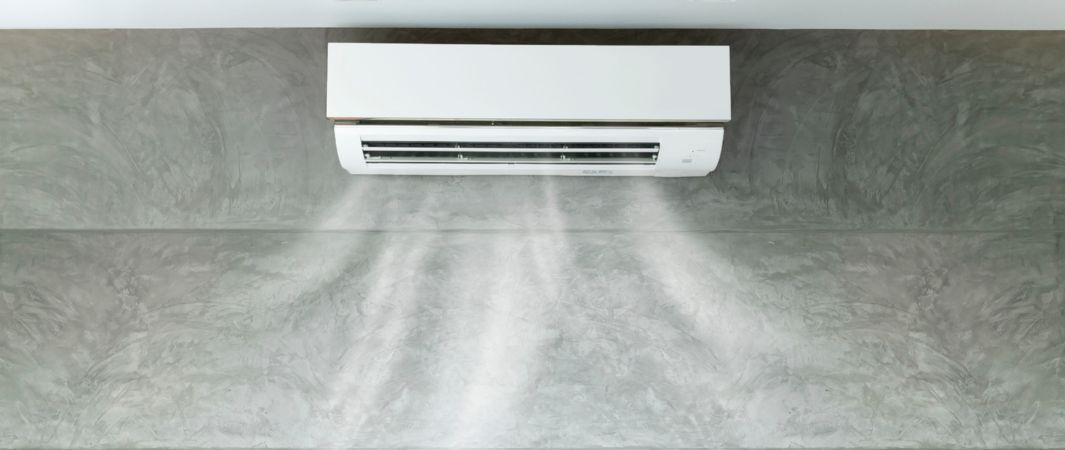
Wall-mounted air conditioning units are typically installed at the top of the wall, approximately 15–20 cm below the ceiling. The reasons are:
- warm air accumulates near the ceiling,
- the unit draws it in, cools it, and then directs it into the room,
- this ensures a more natural air circulation.
Installing the unit too low can cause cold air to blow directly on people in the room, causing discomfort.
Airflow Direction
The ideal direction is one that:
- does not blow directly at people (bed, sofa, desk),
- allows air to circulate freely throughout the space—toward the open part of the room, not “into a corner,”
- It does not blow air directly onto sensitive areas, such as children’s beds or workstations where people sit for long periods.
In practice, this means that the indoor unit should be oriented so that the airflow is directed along the wall or over the area where you are spending time, rather than directly at you.
Distance from Obstacles
The indoor unit should not be placed too close to:
- above a tall cabinet,
- next to a massive pillar,
- in a narrow niche.
Obstacles prevent proper air intake and circulation, which reduces efficiency and can lead to uneven cooling in the room. Manufacturers typically specify minimum distances from the ceiling and walls—it’s worth adhering to them.
Placement in Relation to Heat Sources
The indoor unit should not be installed:
- right next to large windows exposed to intense sunlight,
- above a radiator or other heat source,
- directly opposite a door where drafts often occur.
The air conditioner should operate under conditions that are as stable as possible. If its sensor detects local temperature extremes (for example, directly above a radiator), the control will not be accurate and the comfort level in the room may fluctuate.
Where to Install an Air Conditioner in an Apartment for Comfortable Cooling
Apartment spaces often have limited options—a fixed layout, load-bearing walls, and neighbors. This makes it all the more important to choose a solution that combines comfort, technical feasibility, and reasonable costs.
Where to Install an Air Conditioner in the Living Room
In small and medium-sized apartments, air conditioning is often installed in the living room, which is usually the heart of the home. When the living room is open to the kitchen and dining area, a single unit can significantly improve the climate throughout the entire living area.
It is advisable to choose:
- a wall through which air can flow into the open space,
- positioned not directly above the seat, but rather to the side, so that the airflow isn’t uncomfortable,
- a placement that also takes aesthetics into account—the air conditioner shouldn’t dominate the entire living room.
Where to Install an Air Conditioner in the Bedroom
In the bedroom, it is especially important to avoid having the airflow blow directly on you while you sleep. The following has proven effective in practice:
- mounting the unit on the wall next to the bed or across from the bed so that the airflow is directed away from your head,
- using the “quiet mode” setting and, if available, features that adjust the airflow to accommodate sleep.
With modern units, it is possible to adjust the louvers so that the air is directed more toward the center of the room and bypasses those who are sleeping.
A smaller apartment with a single indoor unit
In studio apartments and smaller two-room apartments, the goal is usually to cool as much of the space as possible with a single unit. It is recommended to:
- Choose a location as close as possible to the center of the layout,
- mount the unit on a wall from which air can be directed toward the living area while also providing a “view” toward the hallway or the bedroom door.
However, it is important to keep in mind that air conditioning is a localized system—in more remote rooms, its effect will be weaker, and it may not be able to replace a separate indoor unit.
Where to Install Air Conditioning in a Single-Family Home on the Ground Floor and Upper Floor
A single-family home offers more possibilities, but also raises more questions—especially in multi-story buildings.
Living Area on the Ground Floor
In single-family homes, the living area is often the largest source of heat—large windows, a living room connected to the kitchen, dining room, and access to the patio.
When designing the system, it is recommended to:
- position the air conditioning unit so that the airflow covers as much of the living area as possible,
- direct the airflow along the length of the room, not directly toward large windows,
- consider installing multiple indoor units or a ducted system for larger areas.
Upper Floor, Hallways, and Staircase
In a two-story house, air conditioning is sometimes installed in:
- the hallway or the stairwell,
- in order to at least partially cool several rooms at once.
This solution can help lower the temperature on the entire floor, but keep in mind that:
- cooling will be less precise,
- the effect depends on whether the doors to individual rooms are open,
- comfort control in a specific bedroom or home office will not be as precise as with a standalone unit.
For stable and comfortable conditions, a standalone solution for key rooms—especially bedrooms and home offices—is optimal.
Multiple indoor units and multi-split systems
For larger homes, a multi-split system is a common solution:
- one outdoor unit,
- multiple indoor units in different rooms.
In this case, it is important to plan:
- the placement of each indoor unit according to comfort principles,
- reasonable routing of the ductwork,
- the appropriate location of the outdoor unit, taking into account the length of the ductwork and elevation differences.
Placement of the Air Conditioning Outdoor Unit
The outdoor unit of an air conditioning system is often underestimated, yet it significantly affects the system’s efficiency, noise level, and service life.
Adequate air intake and exhaust
The outdoor unit requires:
- open space in front of the fan and heat exchanger,
- unobstructed airflow around the unit.
It is not recommended to:
- “embedding” it in narrow recesses without air circulation,
- covering it with dense covers that restrict airflow,
- Do not install it too close to a wall or the corner of the balcony.
Restricted airflow reduces efficiency and increases the load on the compressor.
Noise and Vibration
When choosing a location for the outdoor unit, consider:
- your own comfort—especially the windows of bedrooms and living areas,
- neighbors—distance from their windows and balconies,
- structural considerations—vibrations when mounting on brackets on the facade.
It helps to:
- using a bracket with anti-vibration elements,
- installation on a solid foundation (e.g., a concrete slab) on the ground,
- a reasonable distance from residential windows.
Orientation and Weather Conditions
The outdoor unit should not be:
- exposed to extreme overheating (e.g., a narrow south-facing balcony with no airflow),
- directly under the eaves without a solution for draining water and condensation,
- in a location where snow or ice may accumulate.
The ideal location is one where the unit is:
- protected from direct rain and snow,
- has good airflow,
- is accessible for service.
What to Definitely Avoid When Installing an Air Conditioner
When deciding where to place an air conditioner, it’s best to avoid these mistakes:
- placing the indoor unit directly above a bed or workspace,
- installing it above a tall cabinet that blocks airflow,
- installing it in narrow niches or corners where air circulates only locally,
- an outdoor unit without anti-vibration mounts on a lightweight facade,
- Installing the outdoor unit in a location where it does not have sufficient airflow or where it overheats.
A properly designed air conditioning installation is always a compromise between technical feasibility, comfort, aesthetics, and noise requirements. That is why it is important to consult with an expert, rather than simply “choosing any available wall.”
Conclusion
Deciding where to install an air conditioner in an apartment or single-family home is just as important as choosing the unit itself. It affects the comfort, efficiency, noise level, and lifespan of the entire system. For indoor units, it’s important to consider the direction of airflow, installation height, and distance from beds and seating areas, as well as ensuring that air can circulate freely in the room. For the outdoor unit, the key factors are sufficient air intake and exhaust, a suitable location in terms of noise, and easy access for servicing.
If you’re planning to install an air conditioning system or upgrade an existing one, the placement of the units should be a natural part of a professional design. This will ensure you get a system that not only cools your home but also operates efficiently, quietly, and comfortably over the long term under the actual conditions of your apartment or house.
When choosing a suitable solution, you can also check out the air conditioners available in our selection.

FAQ
Ideally, place it where the air will spread evenly throughout the room and won’t blow directly on people.
A direct flow of cold air can cause discomfort, drafts, or health problems.
Ideally, place it out of the direct airflow toward the bed—for example, so that the air flows across the room rather than directly onto the sleeping people.
An ideal location is one where the airflow won’t blow directly onto the couch and, at the same time, can evenly cool the most frequently used part of the room.
It is important to have good service access, adequate airflow, condensate drainage, and an appropriate solution to minimize noise for neighbors.
Proper placement affects comfort, noise levels, cooling efficiency, energy consumption, and the lifespan of the air conditioner.