 info@slovklima.sk
Heat Pumps and Solar Power: Why They Make Sense Together

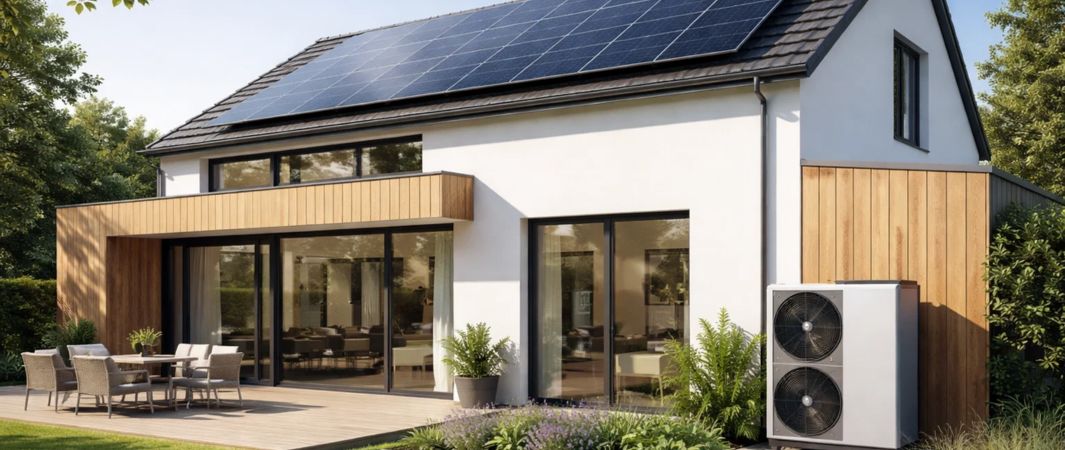
Heat pumps and solar panels are among the solutions that are increasingly being combined into a single energy concept. The reason is simple. A heat pump requires electricity to operate, and photovoltaics can generate that electricity on-site during the day. If these two systems are properly designed, they can complement each other well and provide a practical solution for heating, hot water, and the building’s day-to-day operations.
Many people view this combination primarily in terms of cost savings. That’s natural, but it’s not the only reason why it makes sense to integrate a heat pump and photovoltaics. Equally important is the overall operational logic, better utilization of self-generated electricity, and the ability to view the building as an interconnected system rather than a collection of separate technologies.
How Heat Pumps and Photovoltaics Work Together
The principle is essentially simple. The photovoltaic system generates electricity, and the heat pump uses it to operate. This means that when the photovoltaic system generates electricity during the day, the heat pump can use part of that energy for heating, domestic hot water, or—in the summer—for cooling, if the specific system allows it.
In practice, however, it’s not just a matter of one system “powering” the other. What matters is how the entire operation is set up. If the system is well-designed, part of the electricity generated is consumed directly on-site, reducing the need to draw power from the grid. This is precisely where the main benefit of this combination lies.
Heat pumps and photovoltaics therefore work best when viewed as a single, integrated concept—not as two separate technologies that just happen to coexist in the same home.
Heat pumps and photovoltaics aren’t an automatic guarantee of maximum savings
This is an important point that’s worth stating clearly. The mere fact that you have a heat pump and solar panels does not mean the result will automatically be optimal. A great deal depends on the specific building, how it is used, the technical design, and how both systems are configured.
Key factors include, for example:
• the building’s heat loss,
• the size and orientation of the photovoltaic system,
• the type of heating system,
• the method of hot water production,
• the operating mode throughout the day,
• and how much electricity is consumed directly in the building.
This means that while this combination may be very effective for one project, its benefits may be less significant for another. That’s why it doesn’t pay to think in terms of “I’ll just add solar panels to a heat pump and that’ll be it.” It’s much more important to know what you expect from the system and how it should function in normal operation.
When Does This Combination Make the Most Sense?
Heat pumps and solar panels are particularly attractive in situations where the long-term operation of a building is a priority and where optimizing electricity consumption throughout the year is important. This can be very beneficial for new construction, but also for renovations, provided the entire system is well-designed.
It is particularly practical when:
• the building is designed or modified for more efficient operation,
• heating is provided by a low-temperature system,
• there is actual electricity consumption during the day,
• domestic hot water production is also addressed,
• the investor wants to integrate the technologies into a single logical system.
It is also important to note that photovoltaic systems generate the most electricity during the day, when the sun is out. A heat pump, on the other hand, does not operate in the same way throughout the day or the year. If these two systems can be coordinated effectively, the result can be much better than if each system were considered separately.
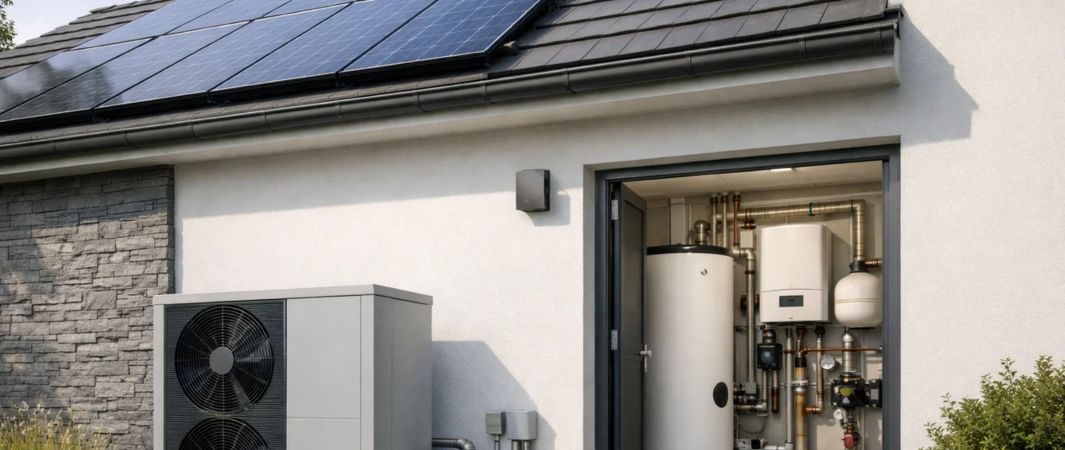
Hot water plays a major role
When combining a heat pump with photovoltaics, the focus is often on heating, but domestic hot water is just as important. Heating domestic hot water can be a very practical way to use the electricity generated during the day.
If the system allows for smarter management, some of the energy from the photovoltaic system can be used specifically to heat the DHW tank when electricity generation is higher. This can make sense because the demand for hot water is relatively stable throughout the year, not just during the winter season.
From a design perspective, therefore, it is not enough to focus solely on heating. In a well-designed system, DHW production can be a key component of the overall logic behind the integration of both technologies.
Proper system control is also important
For a heat pump and a photovoltaic system to work well together, control is of great importance. It is not enough simply to have both technologies in a single building. It is important that the system be able to respond intelligently to electricity generation, heat demand, and current operating conditions.
In practice, it can be advantageous to configure the system so that it can:
• prioritize self-generated electricity,
• efficiently manage hot water heating,
• adapt operation to daily production,
• respond intelligently to seasonal changes.
This is often where the difference between an average and a well-designed solution becomes apparent. It’s not just about choosing the right equipment, but also about how the components will communicate with each other and how they will perform in everyday use.
What to Watch Out for in the Design
With this combination, it’s not worth making decisions based solely on the feeling that “both technologies are popular today.” It’s important that the design be based on the specific building and its actual usage.
Particular attention should be paid to:
• proper sizing of the heat pump,
• appropriate size of the photovoltaic system,
• type of heating in the building,
• sufficient technical space,
• method of control and integration of the technologies.
If any of these factors is underestimated, the system may function, but it may not reach its full potential. And that is often the biggest mistake with this combination—the technologies are high-quality, but they are not designed to work together as a single system.
Conclusion
A heat pump and solar panels can together create a very interesting and practical solution if they are properly designed and integrated. It’s not just a matter of savings, but also of the overall operational logic, better utilization of the electricity generated, and greater comfort during long-term use of the building.
For this combination to make real sense, it is important to look at the entire system holistically. The type of building, the heating system, hot water preparation, and the method of controlling the systems are all key factors.

FAQ
A heat pump uses electricity for heating, cooling, or water heating, and a photovoltaic system can generate some of that electricity directly from the sun.
If a heat pump uses electricity generated by photovoltaic panels, the amount of energy drawn from the grid is reduced.
Yes. Excess electricity from photovoltaic systems can also be used to heat water or to power a heat pump.
It makes the most sense for well-insulated homes, with properly designed capacity and a system that can effectively utilize the electricity generated.
It is important to properly size the heat pump, determine the size of the photovoltaic system, assess household energy consumption, consider energy storage, and choose the right control method.
Not always. Electricity generation depends on the weather, the time of year, and the home’s energy consumption, so it’s usually still necessary to rely on grid power as well.