 info@slovklima.sk
The difference between a single piston and a two piston compressor: which system is best suited for your needs?


If you’ve reached the point of needing reciprocating compressors, you’ve undoubtedly come across the differences between single-stage and two-stage reciprocating compressors. One of the most important things to remember is that the number of stages does not immediately mean the same number of cylinders. This is a misconception that makes choosing the right compressor a complete science. So what are the biggest differences between the two types of compressors.
Most people have probably seen a model of how an internal combustion engine works. A reciprocating compressor works in a similar way and also has the same components, namely the crankshaft, connecting rod and piston, cylinder and valve head. Let’s say the piston is in the top bore. When the engine starts to drive the crankshaft, the piston moves down and a vacuum is created in the cylinder above it. As it moves back up, the refrigerant is compressed and when a certain pressure is reached, it is forced through the valve into the next component of the cooling system.
Single piston and double piston hermetic compressor are two different types of compressors used in refrigeration systems. Here are the main differences between them.
Design
The main difference between a single-piston and a two-piston compressor is how often the refrigerant is compressed. As the name implies in a single piston compressor it is compressed once and in a two piston compressor it is compressed twice. In the first case, the refrigerant is routed to the condenser after compression in a single stroke. In the latter, the refrigerant is compressed in two cylinders, i.e. twice, in one turn of the crankshaft.
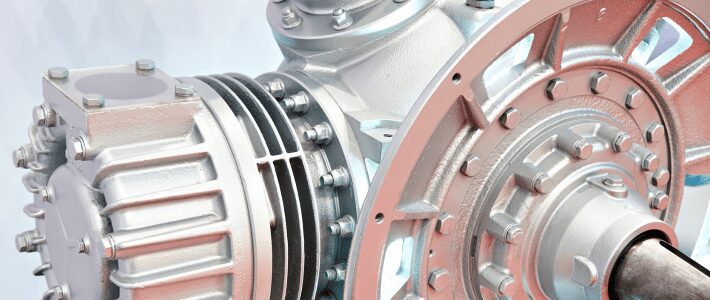
A single piston compressor has a single piston that moves up and down in a single cylinder, compressing the refrigerant. This type is simpler and less complex to maintain. A two-piston compressor has two pistons that can work in one cylinder alternately, or they can be in two separate cylinders. Two pistons provide better balance and efficiency.
Performance and efficiency
Understanding the specific requirements is paramount when choosing between a single piston and a twin piston compressor. For smaller applications, a single piston compressor is often sufficient. It is less maintenance-intensive and usually cheaper.
The two-piston compressor is designed for higher loads. By processing more refrigerant per cycle, it is ultimately not only more powerful, but also more efficient. Efficiency is precisely the reason to reach for a two-piston compressor in larger applications.
Smoothness of operation and vibration
It is clear from the design of the two types of compressors which has the upper hand. Despite being noisier and more vibration pronounced, a single piston compressor can still reliably power smaller applications. These ailments are caused by loads concentrated to a single point.
The two-piston compressor is more balanced due to its design. The delivery of the compressed medium is smoother, and both noise and vibration are lower. This is due to the fact that the pistons balance each other. Noise and vibration are non-negligible aspects of the compressor. Especially at high outputs.
Cooling performance
The cooling performance of the device is dependent on several system components. However, the compressor probably plays the most important role. For small applications, the choice is often easy when the cooling capacity is specified. Lower cost, simpler design and maintenance are in most cases the decisive parameters. For small air conditioners, domestic refrigerators and the like, the single piston compressor is the obvious choice.
Industrial use of single piston compressors is more of a rarity than the rule. The vast majority of compressors found in industry are twin piston compressors. The above-mentioned aspects have a decisive influence: noise, vibration, smoothness and, above all, energy-efficient operation. For exactly the same reasons, two-piston compressors are also used in larger air-conditioning systems.
Lifetime
If one single piston and one two piston compressor were used for the same application, the single piston compressor would most likely be the first to end its life. However, this is logical. The same amount of required media must pass through one cylinder instead of two. A given single cylinder is stressed twice as much as a compressor with two pistons. Vibration also has a significant effect on the service life, which also does not play in favour of the single piston compressor. The more balanced operation and less wear on the individual cylinders tips the scales of durability towards the two-piston compressor.
Air compressors also vary in the length of time they can effectively drive
Price
Everything has its price. Usually, the more components, the more expensive the equipment. This is also true for compressors, where simple single piston compressors are more financially advantageous than their counterparts. Low maintenance costs only underline this fact. No requirement for high performance? Another plus point.
But for larger applications, the tables are turned. Higher input and maintenance costs are offset by the longer life and higher efficiency of two-piston compressors.
Conclusion
With diametric differences in the required cooling capacity, the choice of the right compressor is clear. However, if you are unsure about your application, the Slovklima team will provide all the necessary information.