 info@slovklima.sk
Ducted Air Conditioning for Businesses: When It’s Worth It and What It Offers

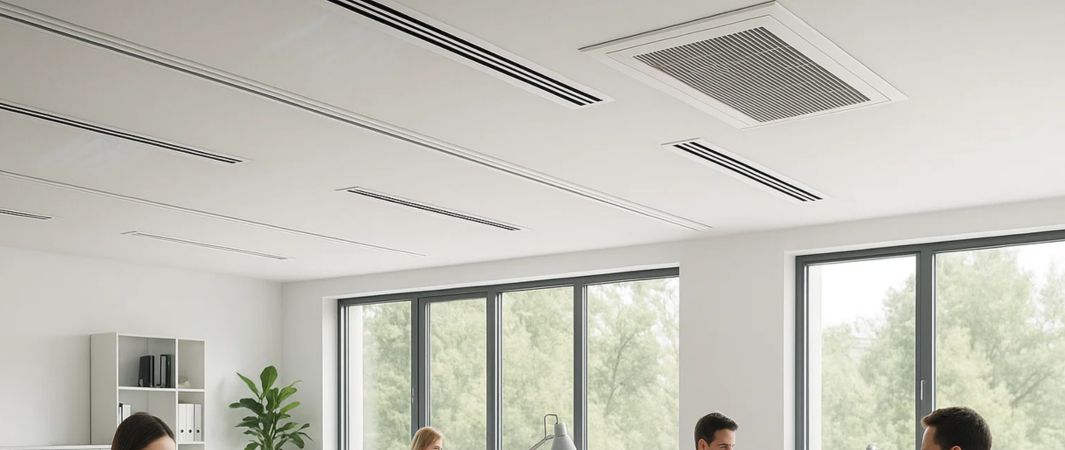
Do you need quiet and unobtrusive cooling for offices, retail spaces, or lodging that won’t detract from the design and will maintain consistent comfort throughout the building? Ducted air conditioning hides the indoor unit out of sight, delivers air through vents to where it’s needed, and allows for uniform zone-by-zone control. We’ll explain when it’s a worthwhile investment for businesses and what specific benefits it offers.
In businesses, first impressions, acoustics, and reliability are key. Ducted air conditioning places the indoor unit in a suspended ceiling or utility room and distributes conditioned air through ducts to offices, conference rooms, or the reception area. The interior remains uncluttered, noise levels are low, and comfort can be controlled by zone based on actual usage. It works best in new construction and renovations with pre-installed suspended ceilings and service access. In existing interiors without space for ductwork, local air conditioning may be a more suitable option. In this article, we’ll focus on the operational benefits, design and installation requirements, as well as capacity selection and zoning. The goal is for the system to operate efficiently and quietly over the long term.
Ducted Air Conditioning in the Workplace: Key Benefits
Here are the main benefits that most often lead companies to choose ducted air conditioning.
- Čistý interiér bez rušivých prvkov:
- The indoor unit is concealed, and only discreet vents are visible in the rooms. As a result, the reception area, meeting rooms, and open-plan office all look neat and professional.
- Tichá prevádzka v pracovných zónach:
- Noise is directed away from offices, and with proper duct design, rooms remain quiet even during peak hours. This promotes concentration and clear conversations.
- Rovnomerná teplota bez prievanu:
- Airflow rates and direction are adjusted to prevent cold spots or direct airflow on people, ensuring consistent comfort throughout the space.
- Zónovanie podľa reálnej obsadenosti:
- Wings, floors, and day and night modes are controlled separately; the system operates only where and when needed, thereby reducing energy consumption.
- Jednotná regulácia a jednoduchý dohľad:
- A single interface for planning, monitoring, and service notifications provides the building manager with a clear overview and speeds up response times.
- Stabilná účinnosť pri dlhom chode:
- Throughout the workday, the system operates smoothly without frequent on-off cycles, which improves both efficiency and noise levels.
- Spolupráca s vetraním a rekuperáciou:
- With properly configured controls, temperature and air quality are maintained at a comfortable level without unnecessary energy consumption.
Note: Ducted air conditioning does not, by itself, supply fresh air; this is provided by a separate ventilation system (e.g., heat recovery/DOAS).
When Is Ducted Air Conditioning a Good Investment for a Business?
- Novostavby a väčšie rekonštrukcie:
- When you can plan suspended ceilings, pipe routes, and service access in advance, it’s easier and more efficient in the long run to achieve a clean interior and quiet operation.
- Open space, viac menších miestností a zóny s rôznou obsadenosťou:
- The system evenly distributes cooling capacity and, through zoning, cools only where it makes sense at any given time.
- Reprezentatívne priestory a retail:
- Reception areas, client zones, and showrooms will benefit from clean ceilings without visible units and even airflow without drafts.
- Dlhší denný chod a stabilná prevádzka:
- Offices and residential spaces, where air conditioning runs for most of the day, benefit from smooth modulation and low noise levels.
- Požiadavka na jednotné riadenie a dohľad:
- Building management has a single system, clear planning, and an overview of conditions, which simplifies maintenance and responses to tenant requests.
What to Keep in Mind During Design and Installation
- Space for the indoor unit and service: Allow for access panels, space for filter replacement, and a reasonable distance from walls, with direct access to the filters, condensate trap, and fan compartment without having to dismantle large sections of the suspended ceiling.
- Duct routing and insulation: Design smooth, continuous routes without sharp bends, using high-quality thermal and acoustic insulation to minimize both heat loss and noise.
- Air outlets and return air: Adapt the placement and direction of airflow to the layout, with an emphasis on workstations and a clearly defined return air path back to the unit.
- Static Pressure (ESP) and Outlet Type: Select the unit based on the required external pressure drop (ESP) and match it with the outlet type (slots, grilles, plenum) to achieve the design flow rate without excessive noise. (added per recommendation)
- Condensate drainage: Proper slope, access to the trap, and reliable drainage are essential; otherwise, odors and leaks may occur. If necessary, use a condensate pump.
- Zoning and control: Carefully plan the zoning, damper types, temperature sensors, and control logic so that the system cools efficiently and comfortably.
- Noise and Vibration: Dampers, anti-vibration pads, and careful installation will minimize the transmission of vibrations to the building structure; this prevents noise from reaching the offices.
- Integration with the building management system (BMS): If you use a BMS, choose a solution with supported interfaces (e.g., Modbus/BACnet) and clear maintenance procedures.

Budget: Initial Cost vs. Operating Costs
The initial investment is higher for a duct-based system, so it pays to use a design that precisely defines capacity, zones, and airflow paths. In day-to-day operation, the system benefits from continuous modulation and occupancy-based control. This means it cools only where and when needed. Over time, total costs depend less on the rated capacity and more on the quality of the design, installation, and control settings.
Conclusion
If you can install drop ceilings, provide service access, and implement well-thought-out zoning, ducted air conditioning is often a worthwhile investment for a business. It provides a quiet, clean interior and centralized control with reasonable energy consumption during long daily operation. In finished interiors without space for ductwork, however, high-quality local air conditioning or a phased, zone-by-zone solution is more practical.
When making a decision, it’s worth relying on the project and proper control settings. These are what turn catalog specifications into actual bills and consistent comfort. You can find the current selection of air conditioning units and installation accessories on the Slovklima website.
FAQ
It is most useful in new construction and major renovations, where wiring, suspended ceilings, and service access can be planned in advance. It is particularly well-suited for larger offices, open-plan spaces, or lodging facilities.
It provides a cleaner interior without visible units, quieter operation, and more even temperature distribution. Another advantage is the ability to better control comfort in different areas of the space.
Not always. If the space doesn’t have enough room for ductwork, drop ceilings, and service access, local units are often more practical. A ducted system is ideal, especially when it’s already factored into the design.
No. Ducted air conditioning does not provide fresh air on its own, so ventilation must be addressed separately—for example, through heat recovery or another ventilation system.
It is important to have sufficient space for piping, service access, proper placement of vents, condensate drainage, and properly adjusted controls. It is precisely these details that significantly affect comfort and trouble-free operation.
The initial investment is usually higher than for simpler solutions. However, the final price depends on the size of the building, the complexity of the installation, and the overall technical design.
