 info@slovklima.sk
Gree Versati III: Powerful heat pump for low operating costs

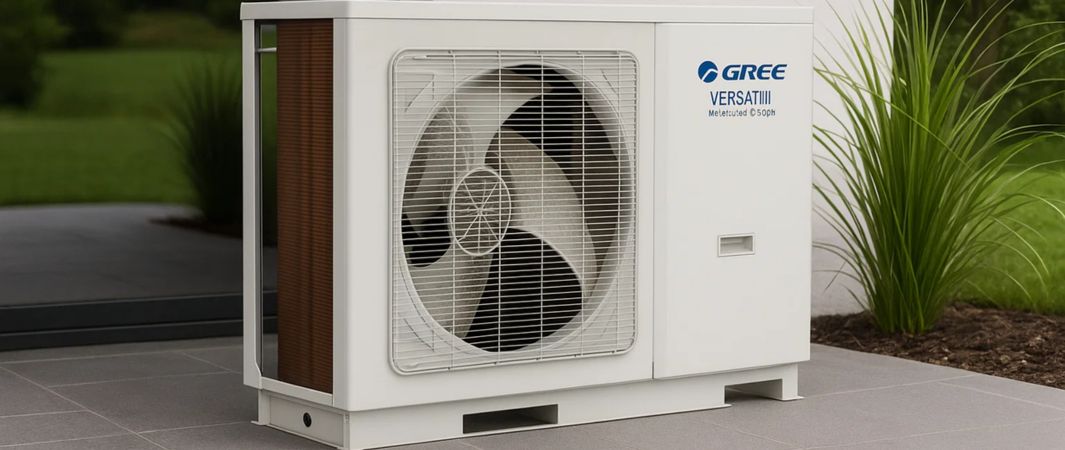
The Gree Versati III heat pump combines heating, hot water production, and summer cooling in a single solution. It operates efficiently in low-temperature systems, maintains a stable temperature, and, thanks to continuous modulation, avoids unnecessary cycling.
If you’re considering a heat pump for underfloor heating or modern radiators, the Gree Versati III is one of the models to consider. When properly sized, it can keep operating costs low. It also offers quiet, smooth operation. In this article, we’ll explain who stands to benefit the most from it. We’ll show you what makes it so energy-efficient in practice. We’ll highlight what to watch out for during installation and control setup. And we’ll explain how to configure the system to save energy without compromising on comfort.
When Is the Gree Versati III the Best Value?
The Gree Versati III offers the best value for money in applications where the system naturally operates in low-temperature mode. Here, you can take full advantage of its smooth output modulation. It works best with underfloor heating and modern radiators. These systems operate efficiently at lower heating water temperatures and do not cause the system to cycle on and off frequently.
Typical real-world scenarios: new buildings with well-designed isothermal control systems. Renovations following insulation upgrades and window replacements. Homes without a gas connection. Also, buildings where, in addition to heating, you’ll appreciate hot water supply and “mild” cooling in the summer.
It helps if the heat distribution system has balanced circuits. The DHW tank is properly sized, and the timing and curves are set reasonably. Under these conditions, the Gree Versati III operates quietly and efficiently over the long term, without unnecessary power reserves.
What Keeps Operating Costs Low with the Gree Versati III
- Low heating water temperature —underfloor heating and modern radiators allow the system to operate at 35–45 °C, which increases efficiency and reduces energy consumption.
- Smooth power modulation – the inverter compressor maintains long, stable operation without frequent on/off cycles; this prevents the system from “chasing” power unnecessarily.
- Proper sizing —the capacity of both the pump and the DHW storage tank should be based on heat loss and actual consumption; unnecessary reserve capacity increases cycling and costs.
- Good system hydraulics —balanced circuits, appropriate flow rates, and sufficient water volume (e.g., an expansion tank) help ensure stable control.
- Equithermal control and sensible programs —curves tailored to your building, nighttime setback, and schedules maintain comfort while minimizing energy consumption.
- Basic maintenance and clean filters/heat exchangers —regular inspection and cleaning maintain efficiency and quiet operation, ensuring that the catalog specifications are realized in practice.
Gree Versati III: System Design and Connection
When choosing a system configuration, the main considerations are where the cooling circuit will be contained and what will connect the outdoor and indoor parts of the system. In a monoblock system, both the compressor and the heat exchangers are located in the outdoor unit, and only the heating water is routed indoors; installation is quick, but it is necessary to ensure that the outdoor piping is properly protected against freezing (glycol, plate heat exchanger, electric cable heating for the pipes, high-quality insulation). A split system divides the circuit into two units with refrigerant flowing between them; it minimizes the risk of water freezing outside the building and allows for more flexible indoor connections, but it requires certified refrigeration installation and precise penetrations.
When installing a DHW system, choose a storage tank with a capacity that matches your household’s actual consumption; one that is too small reduces comfort, while one that is unnecessarily large increases heat loss. Be sure to include a Legionella prevention cycle and ensure that temperature sensors are properly installed. Cooling is primarily achieved through fan-coil units; if you want to use the floor for “mild” cooling, you’ll need dew-point control and proper mixing to ensure the floor isn’t uncomfortably cold and that condensation doesn’t form.
Whether it’s a monoblock, split, or all-in-one system (version with an integrated DHW tank), the energy efficiency of the Gree Versati III relies on smooth, extended operating cycles: balanced circuits, appropriate flow rates, sufficient water volume (e.g., a small storage/separation tank), and equithermal control keep the system stable. The integrated electric backup heater serves as a safeguard for peak demand—set it to assist only when truly necessary, not during every brief drop in temperature.

What to Keep in Mind When Selecting and Installing
- Capacity and Margin —size the system based on heat loss with a reasonable margin of approximately 10–20% to ensure the Gree Versati III runs smoothly without cycling.
- Minimum capacity and modulation – opt for a low minimum capacity and, if necessary, add a small storage/buffer tank to ensure stable operation even during transitional periods.
- System Temperature Mode – ideally 35–45 °C for underfloor heating and modern radiators; for older radiators, consider increasing the surface area, balancing the circuits, and using equithermal control instead of forcing high water temperatures.
- Hydraulics and Fittings – Ensure proper flow rates, check valves, a three-way valve for DHW, a sediment filter, and reliable venting to keep the control system stable.
- Outdoor Unit – A solid foundation, vibration damping, defrost condensate drainage, proper spacing, and reasonable noise levels for neighbors are essential requirements.
- Electrical installation and protection – A dedicated, fused circuit, surge protection, and a high-quality power supply reduce the risk of outages.
- Controls in Practice – Set the equithermal curve to suit your conditions, use a reasonable hysteresis, and limit electric reheating to peak loads only.
- Initial startup and documentation —request a handover report with key parameters so you have a baseline for the first service visit.
Conclusion
If you’re looking for a single solution for heating, domestic hot water, and mild summer cooling, and your system naturally operates in low-temperature mode, the Gree Versati III is a sensible choice to add to your shortlist. When properly sized and with well-configured controls, it can run for long periods smoothly, maintain a stable temperature, and keep operating costs low over the long term.
Before making your final decision, determine the heat loss, the desired heating water temperature, the options for locating the outdoor unit, and the actual DHW consumption; In practice, a high-quality installation and properly tuned operating curves make a bigger difference than any catalog number.
You can view the current selection of Gree Versati III units and installation accessories on the Slovklima website.
FAQ
The Gree Versati III combines heating, hot water production, and mild summer cooling. It is designed primarily for systems that operate in low-temperature mode.
It is most effective with underfloor heating and modern radiators, which operate at lower water temperatures. It works well in new construction as well as in renovations following insulation.
Because it can operate at low heating water temperatures, it features continuous output modulation and, when properly sized, does not cycle unnecessarily.
In a monoblock system, the refrigerant circuit is enclosed within the outdoor unit, and hot water is supplied to the interior. In a split system, the outdoor and indoor units are connected by refrigerant piping.
Yes, but mainly as a mild form of summer cooling. It works best through fan-coil units; with underfloor cooling, you also need to address the dew point and condensation.
