 info@slovklima.sk
Central air conditioning or local units? Overview and comparison

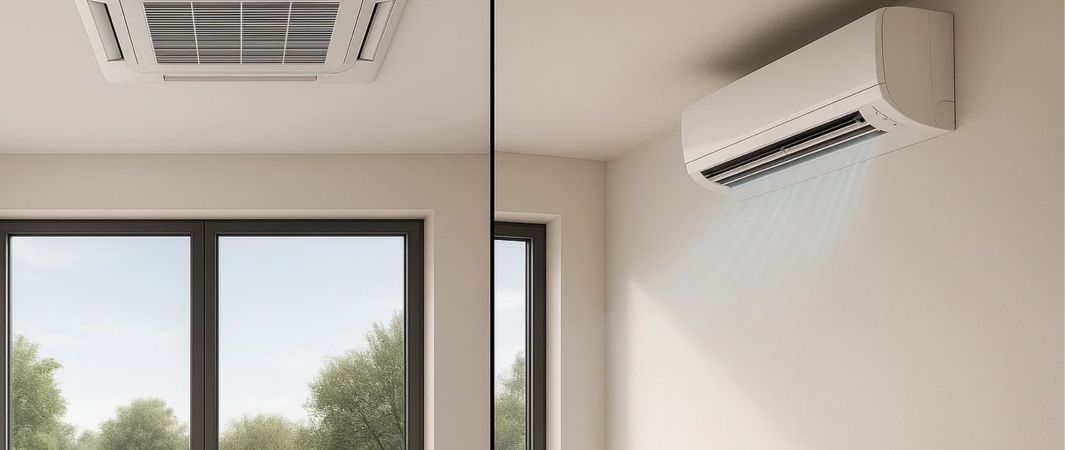
Are you looking for a cooling solution for your home or business and can’t decide between a single concealed system and multiple wall-mounted units? Central air conditioning offers a clean indoor environment, even airflow, and zone control, while individual units provide quick installation and a lower initial investment. In this article, we’ll clearly compare comfort, noise levels, design, space requirements, installation and operating costs, and maintenance so you can choose the system that best suits your building.
By ” central air conditioning,” we mean a single indoor unit concealed in a suspended ceiling or utility room. This unit distributes conditioned air to multiple rooms through ductwork. The air outlets are unobtrusive, and airflow and temperature can be controlled by zone (day/night, floors). Local units are standalone split or multi-split systems designed for specific rooms. Their strengths include quick installation, flexibility, and the ease of adding additional rooms. The differences are not limited to price and installation, but also extend to noise levels, control, aesthetics, and maintenance requirements. It is precisely these practical aspects that we will focus on in our comparison.
Central Air Conditioning: A Comparison Based on Key Factors
Comfort and Control
- Central air conditioning: even airflow, discreet vents, zoning options (day/night, floors). A single control system for the entire house.
- Local units: each room can be set individually (temperature, mode, timer). In smaller homes, this is often sufficient and offers great flexibility.
Noise
- Central air conditioning: the indoor unit is located outside living spaces (ceiling cavity/utility room)—very quiet indoors; it is important to set the airflow rates correctly.
- Local units: Modern models are quiet, but you can still hear the noise right in the room. For bedrooms, be sure to select night mode and choose the right unit size.
Design and Space
- Central air conditioning: Rooms have only vents, no wall-mounted units. Requires space for ductwork and service access to the unit.
- Local units: quick installation without drop ceilings; the indoor unit is visible in the interior (wall-mounted, cassette, window-mounted, etc.).
Installation and Structural Modifications
- Central air conditioning: best planned during new construction or major renovations (suspended ceilings, ductwork, soundproofing).
- Local units: shorter installation time and less disruption; also suitable for finished interiors or rooms being completed in stages.
Costs: Initial Investment vs. Operating Costs
- Central air conditioning: higher initial investment (ductwork, zoning); operation is particularly efficient during prolonged and continuous use.
- Local units: lower initial cost; with multiple rooms and simultaneous operation, the difference in operating costs may decrease.
Service and Maintenance
- Central air conditioning: regular servicing of a single central unit and inspection of filters/ductwork; access must be planned during the design phase.
- Local units: maintenance at multiple locations (each indoor unit separately), but easy access to filters.
Scalability and Future Changes
- Central air conditioning: Changes require modifications to the ductwork; it’s worth planning the zones carefully in advance.
- Local units: You can add additional rooms one at a time (multi-split or standalone units).
How to Decide in Practice: Central Air Conditioning or Local Units
- Space and ductwork routing: If you can install drop ceilings, provide service access, and run thermally insulated ductwork with smooth, uninterrupted routes, central air conditioning makes sense; if not, local units will require less work and allow for faster installation.
- Comfort Control: A shared mode for multiple rooms with zoning works best when controlled centrally, while completely independent room settings are naturally handled by local units.
- Budget and Timing: For a higher one-time investment and a long-term plan, choose a central system; for gradual expansion and a lower initial cost, opt for local units.
- Operation and Maintenance: A single central unit means a single service location plus occasional pipe inspections. With local units, service is divided among the rooms, and filters can be easily cleaned right there on site.
- Noise and Sensitive Areas: To ensure maximum quiet, place the central system’s indoor unit outside living areas and use sound-dampened vents; for standalone systems, choose models with a night mode and appropriate capacity for bedrooms.

Common Mistakes in Air Conditioning Design and How to Avoid Them
- Insufficient drop ceilings and poor duct routing: short access panels, sharp bends, and uninsulated sections increase noise and energy loss; ensure sufficient space, access to the unit, and high-quality insulation are included in the design from the outset.
- Improperly placed vents: Direct the airflow into an open space and ensure proper return airflow; otherwise, comfort will be reduced and drafts will occur.
- Incorrectly sized local units: one that is toopowerful will cycle on and off frequently and cool too aggressively, while one that is too weak will not maintain the temperature; select the capacity based on the thermal load of the specific room.
- Neglected condensate drainage: Incorrect slope and long horizontal runs lead to leaks and odors; design for the correct slope, provide service access, and clean the trap regularly.
- Mixing systems without unified control: Combining central air conditioning with randomly added local units increases energy consumption and drafts; establish uniform control rules or select a single primary system.
Conclusion
If you have space for the wiring and want centralized control throughout the entire house, it’s worth considering a central system. For most existing interiors, however, local air conditioning is more practical, offering quick installation, minimal disruption to the structure, and independent controls for each room. Therefore, base your decision on the layout, the level of comfort you expect, and your budget—not on a one-size-fits-all recommendation.
When implementing local solutions, pay attention to the units’ proper capacity, their placement within rooms, condensate drainage, and high-quality control systems. Well-configured schedules, a quiet night mode, and Wi-Fi control (if available) can significantly increase comfort and keep energy consumption under control. Also consider accessible service and regular filter cleaning to ensure that the specifications on paper translate into real-world performance.
You can find the current selection of local air conditioning units and installation accessories on the Slovklima website.
FAQ
A centralized system controls the operation of multiple zones or rooms, while local units control one or more rooms individually.
Especially when you’re working on a larger project with multiple zones and want a unified design concept for the entire space.
Most often on a smaller scale, such as one or a few rooms, where simpler implementation and minimal construction work are important.
Noise levels depend mainly on properly designed capacity, control, and unit placement. A well-designed system can operate more quietly and reliably.
It depends on the layout and interior design requirements. Different types of units can be adapted to the space, suspended ceilings, and aesthetic preferences.
Not necessarily. When comparing options, you need to consider not only the price of the equipment, but also installation, wiring, technical support, and service.
In particular, the number of zones, space for wiring, service access, condensate drainage, and expectations regarding control.
