 info@slovklima.sk
How a Heat Pump Works: A Simple Guide


Today, heat pumps are among the most frequently mentioned solutions when discussing modern home heating. However, many people are still hesitant precisely because they can’t quite picture how a heat pump works in practice—where it gets its heat from, why it can “heat from the cold,” and what it needs to do so.
In this article, we will explain step by step how a heat pump works, the basic parts of the system, the differences between the individual types and the factors that determine whether it will be really effective in a particular house.
Why it is good to understand how a heat pump works
A heat pump is an investment for many years. If you know how a heat pump works and what you can realistically expect from it, it will be easier for you to decide:
- whether it is suitable for your house,
- what type and performance to choose,
- how to correctly combine it with underfloor heating, radiators or photovoltaics,
- what to avoid when choosing and designing a system.
The goal is not to make you a designer – it is enough if you understand the basic principle and connections. Everything else is up to a professional design.
How a heat pump works – basic principle
Simply put, a heat pump transfers heat from a place where it is relatively unusable (for example, outside air at +2 °C) to the heating system in the house, where we need it at a higher temperature (for example, 35–45 °C to underfloor heating or radiators).
The principle is similar to that of a refrigerator – just turned “upside down”:
- Heat source
The heat pump draws energy from the surrounding environment:
- from the air (air-water, air-air),
- from the ground (ground-water via vertical wells or surface collectors),
- from water (water-water – underground, surface, process water).
- Evaporator
A refrigerant circulates in the heat pump and evaporates at a low temperature. In the evaporator, it absorbs heat from the outside air or ground collector and changes from a liquid to a gas.
- Compressor
The compressor sucks in the gaseous refrigerant and compresses it to a higher pressure. As the gas is compressed, its temperature increases – the refrigerant heats up to a temperature at which it can transfer heat to the heating water.
- Condenser
The hot refrigerant flows into the condenser, where it transfers heat to the heating water (for example, for underfloor heating or radiators). In doing so, it liquefies.
- Expansion valve
The liquefied refrigerant passes through an expansion valve, where its pressure and temperature drop – and the cycle can be repeated in the evaporator.
The heat pump does not produce heat by burning fuel, but moves existing energy from the environment to a higher temperature level. That is why it can deliver approximately 3–4 kWh of heat to the system from 1 kWh of electricity (depending on the type, settings and conditions).
What parts does a heat pump consist of
To make it clearer how a heat pump works in a real device, it is worth knowing its basic parts:
- Evaporator – the place where the refrigerant receives heat from the outside environment.
- Compressor – the “heart” of the system, which compresses the refrigerant and raises its temperature.
- Condenser – a heat exchanger where the refrigerant transfers heat to the heating water.
- Expansion valve – a component that reduces the refrigerant’s pressure before it enters the evaporator.
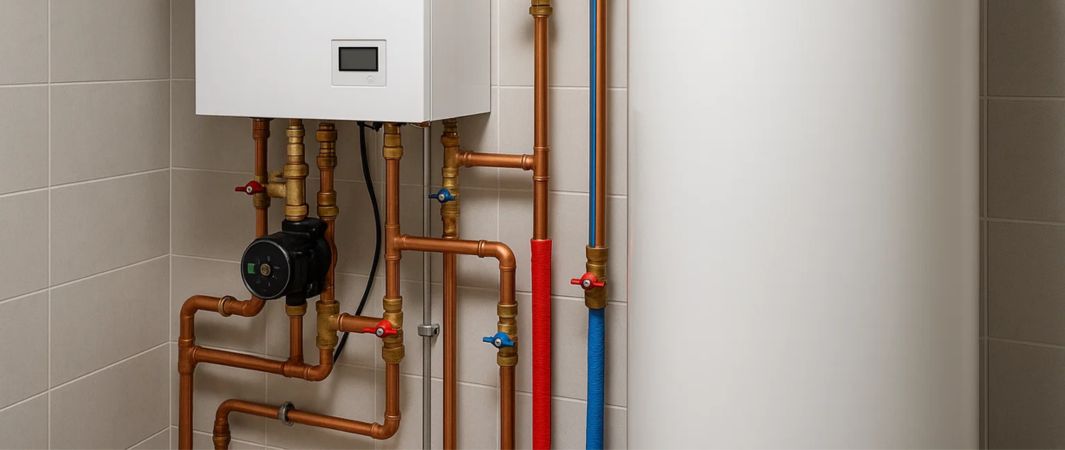
- Circulation pumps and hydraulics – ensure water circulation within the system (to radiators, underfloor heating, and the DHW tank).
- Control unit – the “brain” of the system, which controls the compressor, circulation pumps, defrosting, and individual operating modes.
Depending on the specific system, these components may be housed in a single compact unit (known as a monoblock) or divided into an outdoor and indoor unit (split system).
How a heat pump works in different types of systems
The principle is always the same; the main difference lies in where we get the heat from and how we use it in the house.
Air–water
The most common solution for single-family homes:
- Heat is extracted from the outside air,
- Hot water from the heat pump flows to the radiators, underfloor heating, or the DHW tank.
Advantages:
- simpler installation (no drilling, no excavation),
- lower upfront costs.
Disadvantage:
- Efficiency fluctuates more—at low outdoor temperatures, the heat pump has to work “harder.”
Ground-to-water
Heat is extracted from the ground using boreholes or ground-source heat collectors:
- the temperature in the ground is more stable throughout the year than the air temperature,
- the system generally has higher and more stable efficiency.
Disadvantage:
- Higher initial investment (boreholes or excavation work),
- suitable land and geological conditions are required.
Water–Water
Thermal energy is drawn from groundwater or surface water:
- Very good efficiency (water has a stable temperature),
- suitable where appropriate water sources and regulatory permits are available.
Disadvantage:
- more demanding design,
- water quality requirements, and permits.
Air-to-air
Often known primarily as air conditioners with a heating function:
- Heat is extracted from the outside air,
- It is transferred directly to the indoor air via the indoor units (no heating water).
Suitable as supplemental heating or for well-insulated buildings.
How a Heat Pump Works in Practice: What Affects Efficiency
How a heat pump performs in a real home depends on several factors—it’s not just about the brand and the rating on the label.
Temperature difference
The most decisive factor is the difference between:
- the source temperature (air, ground, water),
- the desired temperature of the heating water.
The smaller the difference, the more efficiently the heat pump operates. Therefore:
- a heat pump “loves” low-temperature systems (underfloor heating, large-surface radiators),
- High water temperatures (70–80 °C) are more demanding—which is why a special high-temperature heat pump is the best option in such cases.
System Design and Sizing
Even high-quality equipment can malfunction if:
- it is oversized —resulting in frequent starts and stops,
- it is undersized —it cannot keep up with heat loss and must often be supplemented by another heat source.
It is important to:
- correctly calculate a building’s heat loss,
- take actual conditions into account (insulation, windows, how the house is used),
- design an appropriate water temperature and heating system.
Control and Operation
How a heat pump operates on a typical day is significantly influenced by:
- the equithermal curve settings (the relationship between outdoor temperature and heating water temperature),
- proper zoning (separate circuits for underfloor heating, radiators, and DHW),
- the ventilation method (drafts and unnecessary heat loss).
Proper control can make the difference between “on-paper” efficiency and actual satisfaction during operation.
Myths and Reality: How a Heat Pump Works in Winter
There are many myths circulating about how a heat pump works in winter. Among the most common are:
- “At –10 °C, the heat pump no longer works.”
Modern systems are designed to operate even at significantly lower temperatures. Although efficiency decreases, the system does not stop working; if necessary, a bivalent heat source (such as an electric heater) is temporarily activated.
- “When it’s cold outside, there’s nothing to draw heat from.”
Air retains heat even at sub-zero temperatures—a heat pump operates based on temperature differences and utilizes the physical properties of the refrigerant.
- “A heat pump in an older house makes no sense.”
In many older houses, a heat pump makes sense – especially after insulation or sensible system modification. Sometimes a high-temperature heat pump is suitable, sometimes a combination with radiators and underfloor heating.
It is important to assess the specific building, not universal statements.
Conclusion
If you understand how a heat pump works, it will be easier for you to decide whether it’s right for your home and what type of system to choose. The principle is always the same—extracting heat from the environment and “moving” it to a higher temperature level using a refrigerant and a compressor. Whether the solution will be cost-effective and reliable in practice depends primarily on proper design, sizing, the type of heating system, and high-quality control.
If you’re considering a heat pump for a new construction or the renovation of an existing building, it’s worth choosing not only a brand but also a partner who understands both the technology and the actual conditions in the building. Slovklima offers heat pumps for various types of buildings and expert advice on selecting a specific solution so that the system makes both technical and economic sense and operates reliably for many years.
FAQ
A heat pump extracts heat from the environment, transfers it through a closed circuit using a refrigerant, and then transfers it to the heating system.
Most often from the outside air. It is this air that serves as the source of energy, which the unit extracts and then uses for heating or hot water.
The key components are the evaporator, compressor, condenser, and expansion valve. Each of these components plays a role in heat transfer and heat exchange.
The compressor compresses the refrigerant, thereby increasing both its pressure and temperature. This allows heat to be transferred to the heating system.
Yes. Modern heat pumps can operate even at low temperatures, and an auxiliary heat source can help in extreme conditions.
Yes. Some models can reverse the process in the summer and, instead of heating, remove heat from the interior to the outside.
