 info@slovklima.sk
Refrigerated doors: what to look out for when choosing


Maintaining optimum temperatures in freezing and cold storage facilities is a key factor for efficient and safe operation. Maintaining a stable temperature in controlled zones is crucial, as any unplanned leakage can have a significant impact on both the quality of stored products and costs. It is therefore essential that cold storage operations choose cold storage doors that have high quality insulation and are specially designed for the type of environment required. But which refrigeration doors are the most ideal choice?
When choosing a refrigerated door, the closing and opening speed is very important. There are so many to choose from on the market today that it is no problem to ensure that an expensively manufactured refrigeration door does not vent unnecessarily. Of the many products available on the market today, refrigeration doors are also reliable in resisting both frost and moisture and are characterised by very high quality insulation.
Refrigerated doors as a key factor for reliable operation
Refrigeration doors play an indispensable role in the functioning of any cold storage or freezer operation. Every degree of temperature and even the slightest leakage of energy means the difference between gain and loss. Refrigeration spiral doors with a seal around the perimeter of the opening are very effective. These doors are also resistant to frost formation.
In general, however, cold rooms can be equipped with two types of doors, which can then be divided into several types and shapes, exactly according to your requirements. Based on the temperature, we divide the doors of these specific rooms into cold storage and freezer rooms. Refrigerated doors are designed for cold rooms and rooms where the temperature is above freezing. However, at lower temperatures we are already talking about freezer doors. However, if the temperature in the refrigerated space is consistently above 12 °C, it is also possible to reach for a so-called semi-insulated door.
Types of refrigeration doors
Refrigerated doors are basically made to measure. This is in order to meet the exact requirements and needs of a given space, such as door dimensions, insulation properties and so on. On the other hand, there are also refrigeration doors on the market that are of standard sizes and shapes, they are produced in larger quantities and so their price tends to be lower.
One such type is the revolving refrigerated door. Their core is a rigid polyurethane, which is sandwiched between two sheets enclosed by anodised aluminium. The door frame is lined with a special rubber gasket. The leaf of such doors is usually 7 to 9 centimetres thick, depending on the desired temperature of the refrigeration or freezing room. In specific cases, the thickness of the door leaf can reach up to 12 centimetres. Such doors can be used in rooms with temperatures ranging from -20 °C to -30 °C.
The revolving refrigerator door also includes a plastic frame and a hollow frame for easy installation.The height and width of the door ranges from 700 mm to 2000 mm to 1400 mm to 2400 mm.
Another type of refrigerated doors are sliding doors and PVC strips. These are made up of a guide rail in addition to the sash itself. The sash is composed of a sandwich panel with polyurethane insulation, which has a density of 41 kg/m3. As with the revolving door, this type is protected by an aluminium frame and a high quality seal around the entire perimeter.
Refrigeration facilities may also choose fire doors, quick release doors and gates, or PVC strips.
The PVC strips can be used to create a separate refrigerated space, but they can also serve as a complement to the refrigerated door. It is a barrier that prevents air flow when the refrigeration door is open. The belts are normally supplied in two variants, ST 200 x 2 and ST 300 x 2. The ST 200 x 2 is 200 x 2 mm with a 50 mm overlap, while the ST 300 x 2 with 300 x 2 mm offers a 100 mm overlap.
Refrigerated door construction
Refrigerated boxes are an integral part of many industries. High-quality cold storage doors are crucial to their proper functioning. Cold room doors have a high insulation capacity to minimise heat leakage. Especially the materials and seals used have a significant impact on maintaining consistent temperatures inside the cold room. As technology advances, innovations such as doors with automatic opening and closing are also emerging, increasing efficiency and convenience for users.
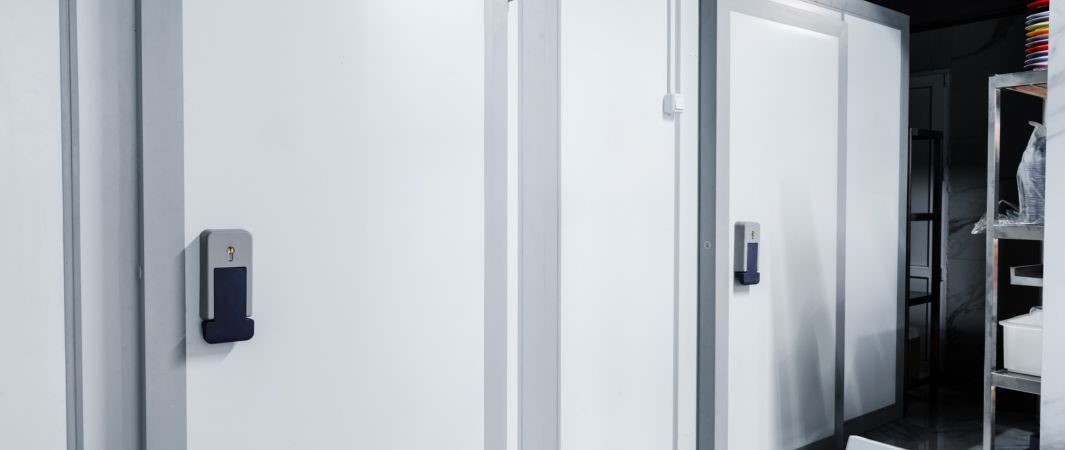
Refrigerated doors normally consist of a thermal insulation core, a frame and a door frame. The core of the cold store door consists of polyurethane foam which is injected under a press between the two sheets forming the surface of the door together with the aluminium frame. This technology ensures that the door is monolithic, strong and rigid, even without the use of other fasteners. Polyurethane, in turn, guarantees high quality thermal, acoustic and hygienic insulation properties.
The frames of such doors, which need to meet specific temperature parameters, are designed with rigid aluminium profiles. These are bonded to the panel so that thermal bridges do not form, along with any icing. In addition, the profile is manufactured in such a way as to allow easy installation. The seals are, of course, made of a material that can withstand mechanical stress at low temperatures over a long period of time. Doors designed for refrigerated spaces are equipped with a safety opening system or lock, so they can be opened from the inside even if they are locked.
Flanges are commonly constructed in a U-shape for anchoring to a construction opening in the panel. However, it is also possible to obtain a flat door frame for a brickwork opening or an L-shaped door frame. As far as thresholds are concerned, refrigeration doors are in most cases thresholdless, but in the case of specific needs, these can also be supplied and manufactured.
Insulation and energy saving
Refrigerated doors have great insulating properties that save on space cooling costs. Highly functional insulation is provided by thermally separated and insulated slats. However, the overall value of the insulating properties depends on the size of the door. This is an important aspect, especially if maintaining a stable temperature is critical for product quality.
Refrigerated doors can function reliably and for a long time even in extreme conditions of cold, frost and humidity. Among other things, they are also equipped with many safety features. We will be happy to guide you through the selection of the right refrigeration door. Do not hesitate to contact the expert and long-standing market partner Slovklima.